
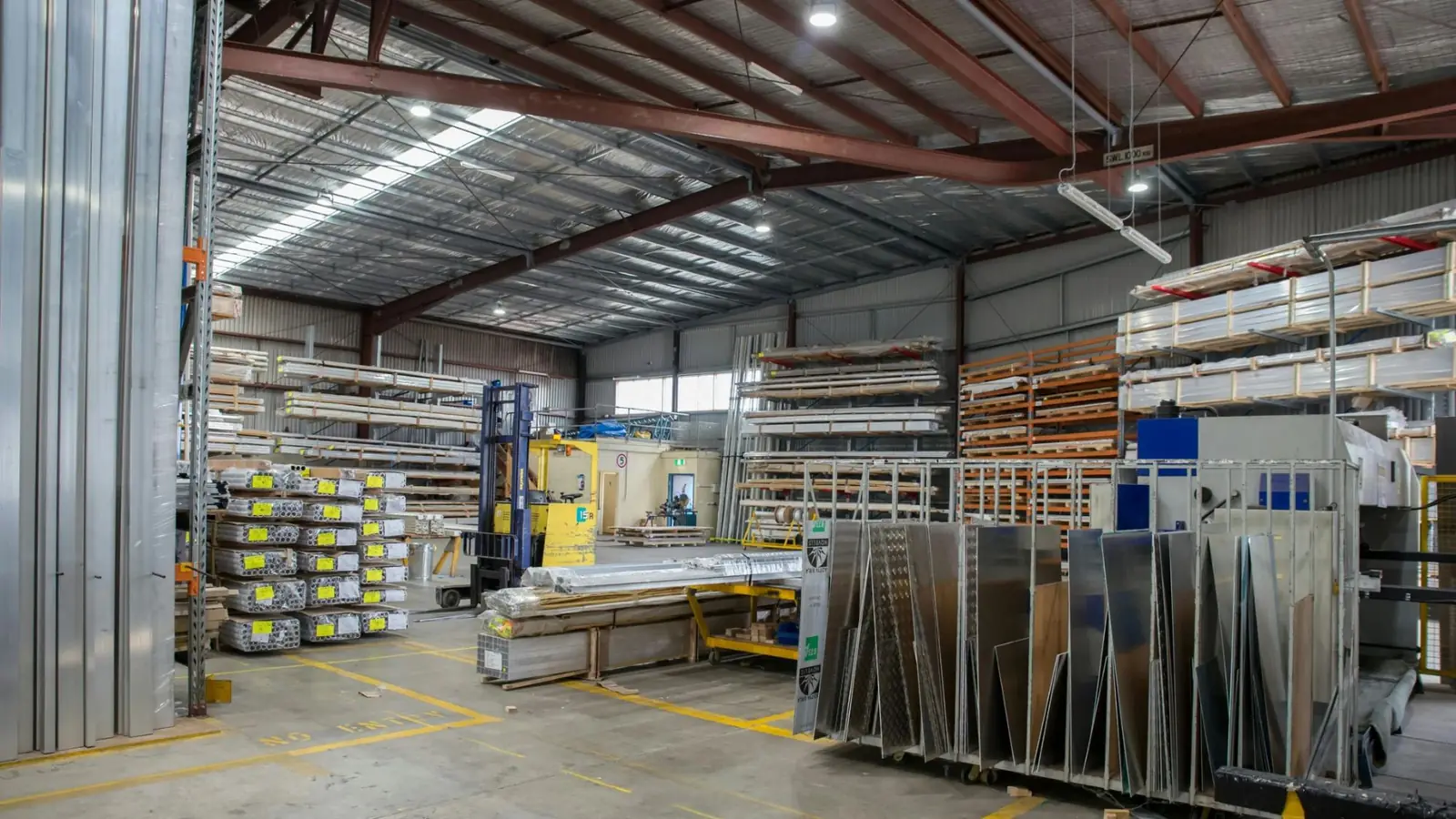
Once a warehouse stores high-piled combustibles, the Fire Code grades it extra hazard. The smallest 2-A extinguishers are no longer acceptable, and each unit covers less floor.
A Milton warehouse needs extinguishers spaced to the Fire Code's travel and area limits, sprinklers kept clear of stock and in operating condition, and emergency lighting tested every month and every year. Racking height drives most of it: once a warehouse stores high-piled combustibles, the Fire Code grades it extra hazard, which rules out the smallest extinguishers. Milton Fire & Rescue also uses Supra lock boxes to get crews into commercial and industrial buildings when nobody is there to open the door.
Walk a distribution floor at the end of a night shift and the risks show up in ordinary places. Shrink wrap piles up beside a dock door. A reach truck has scraped the guard on a sprinkler head above aisle 14. An extinguisher hangs on a column now hidden behind a new pallet position. All three break a Fire Code rule, and a careful walk-through finds them before an inspector does.
Is your warehouse ordinary hazard or extra hazard?
The Fire Code grades every area by how large a fire could get, and the grade sets how much extinguisher coverage you need.
- Ordinary hazard: the Code lists warehouses not classified as extra hazard here, along with stores, display rooms, parking garages, and light manufacturing (6.2.5.2).
- Extra hazard: the Code lists warehouses with high-piled combustibles here, along with mercantile storage areas, woodworking, auto repair, and processes that use flammable or combustible liquids (6.2.5.3).
The grade can change without a single wall moving. Taller racking or a new customer's stock can turn an ordinary hazard floor into one with high-piled combustibles, which the Fire Code grades as extra hazard. When your storage changes, have someone check the grade before the next inspection.
How many extinguishers does a Milton warehouse need?
Table 6.2.6.A of the Fire Code sets two limits for Class A extinguishers: nobody travels more than 25 m to reach one, and each unit protects a maximum floor area based on its rating and the hazard grade.
For warehouse floors, the area limits per extinguisher are:
- Ordinary hazard: 300 m² for a 2-A unit, 600 m² for 4-A, 900 m² for 6-A, and 1,100 m² for 10-A
- Extra hazard: 2-A not acceptable, 300 m² for 3-A, 400 m² for 4-A, 600 m² for 6-A, 900 m² for 10-A, and 1,100 m² for 20-A
A worked example
Take a 5,000 m² storage floor.
- Graded ordinary hazard with 4-A units: 5,000 divided by 600 gives 8.3, so the floor needs at least nine.
- Graded extra hazard with 4-A units: 5,000 divided by 400 gives 12.5, so the same floor needs at least thirteen.
- Graded extra hazard with 10-A units: 5,000 divided by 900 gives 5.6, so at least six.
Those are minimums. Long racking aisles force people to walk around the stock, and the 25 m travel limit is measured along that walking route. A warehouse that meets the area count can still need more units to keep every point within 25 m. Our guide to how many fire extinguishers a building needs explains the full table.
Where they go
- In or next to the aisles and corridors that lead to exits (6.2.1.4)
- Easy to see and reachable at all times (6.2.1.3), which means no pallet positions in front of them
- Marked with signs in large floor areas and wherever visual obstructions can't be avoided (6.2.1.5)
- Mounted with the top no higher than 1.5 m for units of 18 kg or less, or 1.1 m for heavier units without wheels (6.2.4.2 and 6.2.4.3)
An unoccupied warehouse with a fixed fire protection system still needs extinguishers available for the people who respond to it, and the location and number have to be approved (6.2.6.1). If you dispense or store flammable liquids, Class B coverage applies on top of Class A. Our guide to the types of fire extinguishers covers which class goes where.
How do you keep sprinklers working around racking and forklifts?
A sprinkler system protects the building only if water can reach the fire. In a busy warehouse, the threats come from the daily work.
- Keep discharge clear. The Fire Code bars anything placed so it interferes with sprinkler discharge (6.5.1.5). Stock stacked up into the heads, or new racking built under them, can block the spray pattern.
- Don't hang things from the pipe. The Code says sprinkler systems can't be used to support anything that interferes with their performance (6.5.1.5). Signs, cable runs, and extension cords belong on their own supports.
- Guard heads near traffic. Sprinklers need guards where mechanical damage is possible (6.5.6.1). Forklift aisles and loading areas qualify.
- Check heads every year. Heads must be checked at least once a year for damage, corrosion, grease, dust, paint, or whitewash (6.5.3.4).
- Watch the gauges and valves. Water supply and system pressure are checked weekly with the gauges (6.5.3.2). Control valves are sealed open and inspected weekly, or monthly if locked open or electrically supervised (6.5.4.5).
- Test the alarm. The sprinkler alarm is tested monthly by flowing water through the test connection at the valve (6.5.5.2).
Loading docks bring a Canadian problem. A wet pipe system can't be exposed to temperatures below 4°C, and any change in equipment or use that could cool the sprinklers that far requires the system to be altered first (6.5.1.4). If dock doors stay open through a January shift, check that the sprinklers near them can't drop below that limit. Our guide to winterizing commercial sprinkler systems covers dry pipe valves, auxiliary drains, and cold-weather checks.
Inspection, testing, and maintenance done to NFPA 25 is deemed to satisfy the Fire Code's sprinkler inspection, testing, and maintenance subsections (6.5.1.1). Our post on commercial sprinkler inspection lays out the full schedule.
How does sprinkler supervision show up on the fire alarm panel?
Where a sprinkler system is electrically supervised, its switches and flow devices report to the fire alarm panel, and the Fire Code sets test intervals for them (6.5.5.7):
- Transmitters and water flow devices: every two months
- Valve supervisory switches, tank water level devices, and building and tank water temperature supervisory devices: at least every six months
When someone half-closes a valve or the riser room gets too cold, those devices send a supervisory signal to the panel. Our guide to fire alarm panel signals explains what to do when one comes in.
How do you keep a big floor lit when the power fails?
Emergency lights in a warehouse have a long way to throw light, and racking gives them plenty to hit. A head bumped by a mast or a pallet no longer lights the aisle it was aimed at.
- Battery units get a monthly inspection and test, and a full-duration test under simulated power failure at least every 12 months (6.7.1.6).
- Other emergency lights are inspected at least every 12 months (6.7.1.7).
- Exit signs with battery backup are checked monthly and for full duration yearly (6.7.1.8).
Re-aim and re-test heads whenever the racking layout changes. Our post on emergency lighting inspection covers each test step.
What about lithium-ion batteries on the floor?
Electric forklifts, pallet jacks, scanners, and stock all bring lithium-ion batteries into the building. Damaged or overheating cells can enter thermal runaway, and a battery fire behaves differently from burning cardboard. Our guide to lithium-ion battery storage fire safety covers charging areas and storage, and our post on AVD fire extinguishers explains the extinguisher made for battery fires.
Emergency access in Milton: Supra lock boxes and pre-incident planning
Milton Fire & Rescue uses a Supra key lock box system for emergency access when nobody from the building can open the door. The town lists commercial and industrial properties, and facilities with restricted or controlled access, as common places to install one. According to the town, a lock box gives crews immediate access, reduces forced-entry damage to doors, improves response times, and supports firefighter safety. You install, register, or update a box through the Emergency Building Access (Supra) form on milton.ca.
The town also offers a pre-incident planning questionnaire. Milton Fire & Rescue says completing it helps fire prevention staff understand your facility and may support emergency response planning. For a large building with several docks, a sprinkler riser room, and stored hazards, it's worth completing. Our guide to fire inspections in Milton explains how the town's inspections work and how to request one.
Warehouse fire protection in Milton from Boss Fire
Boss Fire has a technician based in Milton who covers Halton and Peel. We inspect and service extinguishers, emergency lighting, exit signs, sprinklers, and fire alarms, so a single visit can cover most of a warehouse. Our technicians are NFPA-certified, our fire alarm technicians are registered with the CFAA, and Boss Fire carries $5 million in liability insurance.
Annual extinguisher inspection starts at $40 per extinguisher, per year, plus one service call fee per visit. Quotes are itemized and answered the same business day, and in the GTA we can be on site within 48 hours. If you run warehouses in several cities, our national accounts program puts every site on one schedule with one point of contact.
Before the visit, work through our Ontario fire inspection checklist for the systems an inspector checks.
Sources and references
- Ontario Fire Code, O. Reg. 213/07, Division B, Articles 6.2.1.3 to 6.2.1.5 (location, access, and signs), 6.2.4.2 and 6.2.4.3 (mounting height), 6.2.5.2 and 6.2.5.3 (hazard grades), 6.2.6.1 and Table 6.2.6.A (distribution of Class A extinguishers)
- Ontario Fire Code, O. Reg. 213/07, Division B, Articles 6.5.1.1, 6.5.1.4, 6.5.1.5, 6.5.3.2, 6.5.3.4, 6.5.4.5, 6.5.5.2, 6.5.5.7, and 6.5.6.1 (sprinklers), and 6.7.1.6 to 6.7.1.8 (emergency lighting and exit signs)
- Town of Milton, Milton Fire and Rescue Services, "Programs and Services" page (Supra lock boxes and Emergency Building Access) and the "Prepare for an Emergency" page (pre-incident planning questionnaire)
- NFPA 25, Standard for the Inspection, Testing, and Maintenance of Water-Based Fire Protection Systems
Frequently Asked Questions
What fire protection does a warehouse need in Ontario? +
A warehouse needs portable extinguishers spaced to the Fire Code's travel and area limits, a sprinkler system kept in operating condition where one is installed, and emergency lighting and exit signs that pass their monthly and annual tests. Larger buildings may also need a fire alarm system and an approved fire safety plan.
Is a warehouse ordinary hazard or extra hazard under the Ontario Fire Code? +
The Fire Code grades a warehouse as ordinary hazard unless it is classified as extra hazard. Warehouses with high-piled combustibles, and mercantile storage areas, are graded extra hazard.
How far apart should fire extinguishers be in a warehouse? +
Nobody should have to travel more than 25 m to reach a Class A extinguisher. Each extinguisher also covers a maximum floor area set by its rating and the hazard grade, so a large floor often needs more units than the travel limit alone suggests.
Do warehouse sprinklers need guards? +
The Ontario Fire Code requires sprinkler guards where sprinklers could suffer mechanical damage. In a warehouse, that means heads near forklift paths, racking, and loading areas.
What is a Supra lock box in Milton? +
It's a secure box that holds keys for emergency access. Milton Fire & Rescue uses the Supra system, lists commercial and industrial properties as common places to install one, and handles installation and registration through its Emergency Building Access (Supra) form.
Need a Fire Safety Assessment?
Our certified technicians handle the full inspection cycle. Same-day service available across the GTA.