
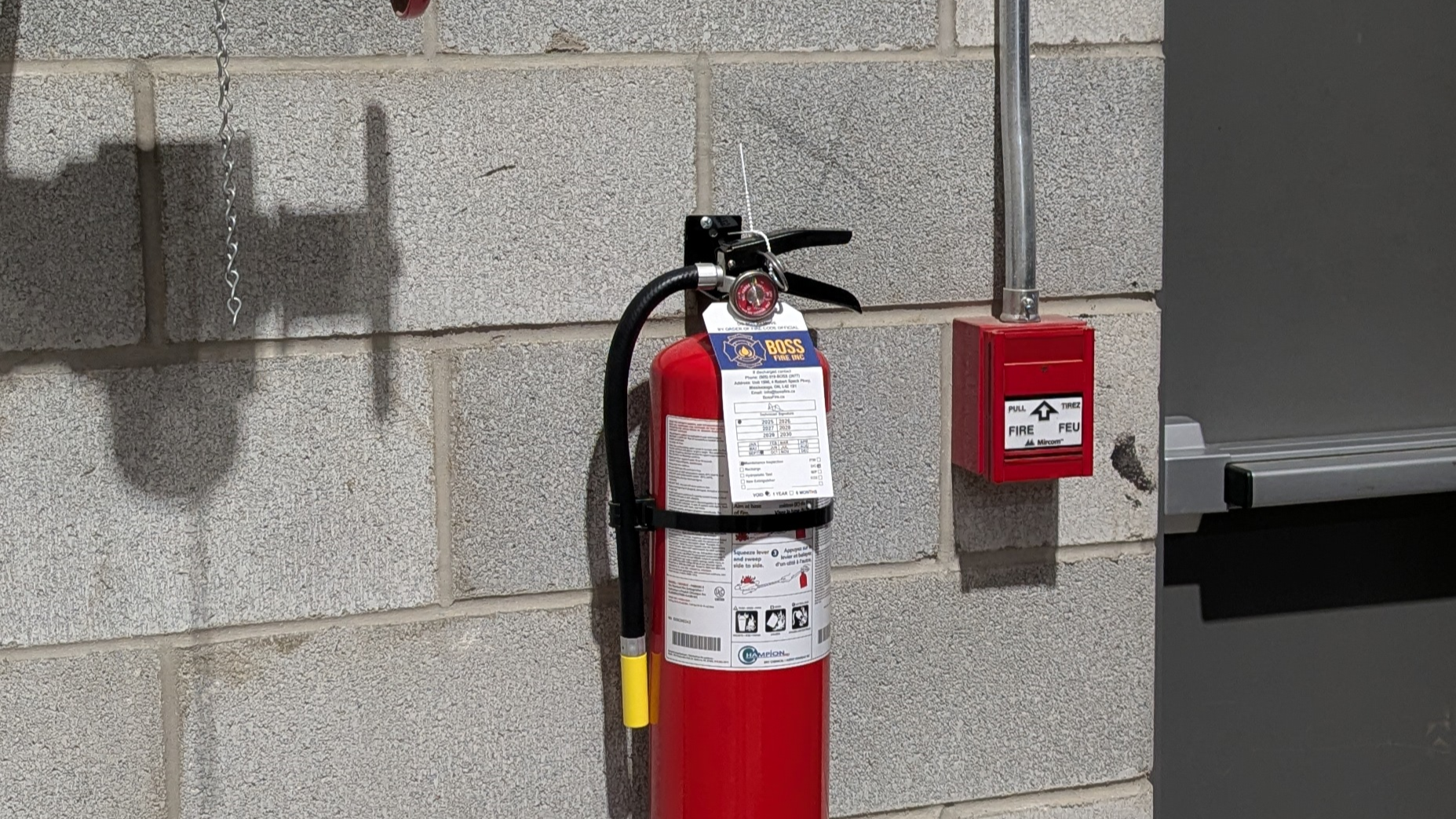
Commercial Fire Extinguisher Inspection & Service
Fire Extinguisher Service.
Done Right, Done On Time.
From a single convenience store to a 40-location national rollout. Inspection, recharging, installation, and certification of every class of portable fire extinguisher, tagged and documented to NFPA 10.
Every unit inspected, recharged, or replaced. Tagged and dated to code.
Portable fire extinguishers are the most-regulated, most-inspected piece of fire equipment on your property. And the most commonly overlooked. A rusted bracket, a dropped pressure gauge, a missing tamper seal. Any of these can fail an inspection and void your insurance.
Boss Fire technicians are NFPA 10 certified and carry every component on the truck. We inspect, service, recharge, and replace on the spot, so you're never running a business with non-compliant equipment sitting on the wall.
Same-day service available across the GTA. Including failed inspections, pre-audit scrambles, and post-discharge recharges.
Every Site Visit Includes
- Visual inspection. Corrosion, dents, hose integrity
- Pressure gauge reading within operable range
- Tamper seal & pull-pin verification, replaced if compromised
- Weight check. Agent quantity to manufacturer spec
- Nozzle & discharge hose check
- Recharge on site if pressure is low
- 6-year internal maintenance when due
- 12-year hydrostatic pressure test when due
- Updated certification tag. Date, technician ID, next service
- Written inspection report for your compliance records

Every class. Every property.
Every building code.
Dry Chemical
The universal workhorse. Combustibles, flammable liquids, and electrical. Standard across retail, office, industrial.
Wet Chemical (K-Class)
Required in commercial kitchens. Designed specifically for cooking-oil fires that dry chemical can't control.
Carbon Dioxide (CO₂)
No residue. Ideal for electrical equipment, flammable liquids, and clean-up-sensitive environments.
Water & Foam
Ordinary combustibles. Paper, wood, fabric. Common in warehouses, offices, storage.
Server Rooms & Labs
Non-conductive, non-corrosive, residue-free. The gold standard for protecting sensitive electronics.
Commercial Vehicles
DOT-compliant for trucks, vans, forklifts, and fleet vehicles. With ongoing inspection cycles managed for you.
How often fire extinguishers
need attention in Ontario.
The Ontario Fire Code adopts NFPA 10 for portable extinguishers (Division B, Article 6.2.7.1). This is the schedule an inspector checks your extinguishers against.
| Frequency | What happens | Who does it |
|---|---|---|
| Monthly | Quick visual check: unit in place and accessible, gauge in the green, pin and tamper seal intact, no damage. Record it in a log. | Owner or designated staff |
| Annually | Full inspection and maintenance, new tamper seal, dated service tag with technician and company name. | Qualified technician |
| Every 6 years | Internal maintenance of stored-pressure dry chemical units: emptied, inspected inside, worn parts replaced. | Qualified technician |
| Every 5 years | Hydrostatic test for CO₂, water, foam and wet chemical (Class K) units. | Qualified technician |
| Every 12 years | Hydrostatic test for stored-pressure dry chemical units. | Qualified technician |
| Class | Fire type | Typical locations | Common extinguisher |
|---|---|---|---|
| A | Ordinary combustibles: wood, paper, cloth, plastics | Offices, retail, warehouses | Dry chemical (ABC), water |
| B | Flammable liquids and gases | Garages, workshops, fuel and paint storage | Dry chemical (ABC or BC), CO₂ |
| C | Energized electrical equipment | Electrical rooms, server rooms | CO₂, clean agent, dry chemical |
| D | Combustible metals | Metal machining and fabrication | Class D dry powder |
| K | Cooking oils and fats | Commercial kitchens | Wet chemical (Class K) |
Sources: Ontario Fire Code, O. Reg. 213/07, Division B, Article 6.2.7.1; NFPA 10, Standard for Portable Fire Extinguishers. Current to the amendments in force January 1, 2026. Last updated .
Related guides
Fire extinguisher service across the GTA
How often do extinguishers really need service? +
NFPA 10 mandates four cycles: monthly visual (by you), annual professional certification, 6-year internal maintenance, and 12-year hydrostatic testing. Boss Fire owns the last three and reminds you about the first.
What if an extinguisher fails an inspection? +
Depending on the issue, a failed unit can usually be serviced on site (recharge, seal replacement, tag update) or swapped for a replacement we carry on the truck. Either way, you leave the visit fully compliant.
Can Boss Fire handle multi-location portfolios? +
Yes. Our National Accounts program is built for multi-site Canadian operations. One contact, one invoice, one standard across every location.
Do you service older or obscure extinguisher brands? +
Yes. Provided the manufacturer is still on the NFPA approved list and the cylinder hasn't been decommissioned. If a unit is obsolete, we'll flag it and replace it with a modern-equivalent rated extinguisher.
A technician on site. Usually this week.
Free site assessment across the GTA. No charge, no obligation. Just a clear quote and a compliant building.