
In Ontario, the annual certification must be performed by a qualified technician with NFPA 10 training and certification. A business owner checking the extinguisher themselves does not satisfy the annual inspection requirement, regardless of how thorough the check.
Here's a scenario that plays out every week somewhere in the GTA. A business owner gets notice their premises will be inspected. They look around, see the red cylinder on the wall, assume everything is fine. The inspector arrives. The extinguisher is three years past its annual certification date, the pressure gauge is in the red, and the unit isn't rated for the fire risk in that area. The inspection fails. The insurance carrier is notified. The business owner is looking at a costly scramble they could have avoided for less than the price of one invoice.
Fire extinguishers are the one piece of fire safety equipment your employees are actually expected to use. They're your first line of defence before the fire alarm brings the fire department — those trucks are 8 minutes away on a good day. Getting extinguishers right isn't paperwork. It's the difference between a fire that stays on one side of a room and one that takes your building.
What NFPA 10 Actually Requires — and What Ontario Enforces
In Ontario, commercial fire extinguisher requirements are governed by two documents working together: the Ontario Fire Code and NFPA 10: Standard for Portable Fire Extinguishers. The Ontario Fire Code explicitly adopts NFPA 10 as the benchmark for portable extinguisher inspection, testing, and maintenance. When your fire inspector shows up, they're measuring you against NFPA 10 standards.
Here's what those standards require on a timeline (full breakdown in how often fire extinguishers must be inspected):
- Monthly — Property owner or designee: Visible, accessible, pin in place, gauge in the green, no obvious damage
- Annual — Qualified technician (NFPA-certified): Full inspection, pressure check, tamper seal, certification tag with date
- Every 6 years — Qualified technician: Internal maintenance — empty, inspect internally, replace components, refill
- Every 12 years — Qualified technician: Hydrostatic pressure testing of the cylinder (every 5 years for CO₂, water and wet chemical units)
The annual inspection is the one most businesses miss — or perform incorrectly. The tag on the extinguisher must show the technician's name, company, date of inspection, and any maintenance performed. A tag without this information is non-compliant even if the unit itself is in perfect condition.
Not All Extinguishers Are Created Equal
This is where many Ontario businesses quietly fail inspection without realising it. The type of extinguisher you need depends entirely on the types of fire risk present in each area of your building. Putting the wrong class of extinguisher in a location doesn't count as coverage — it can make a fire worse.
Class ABC (Dry Chemical) — Most Commercial Spaces
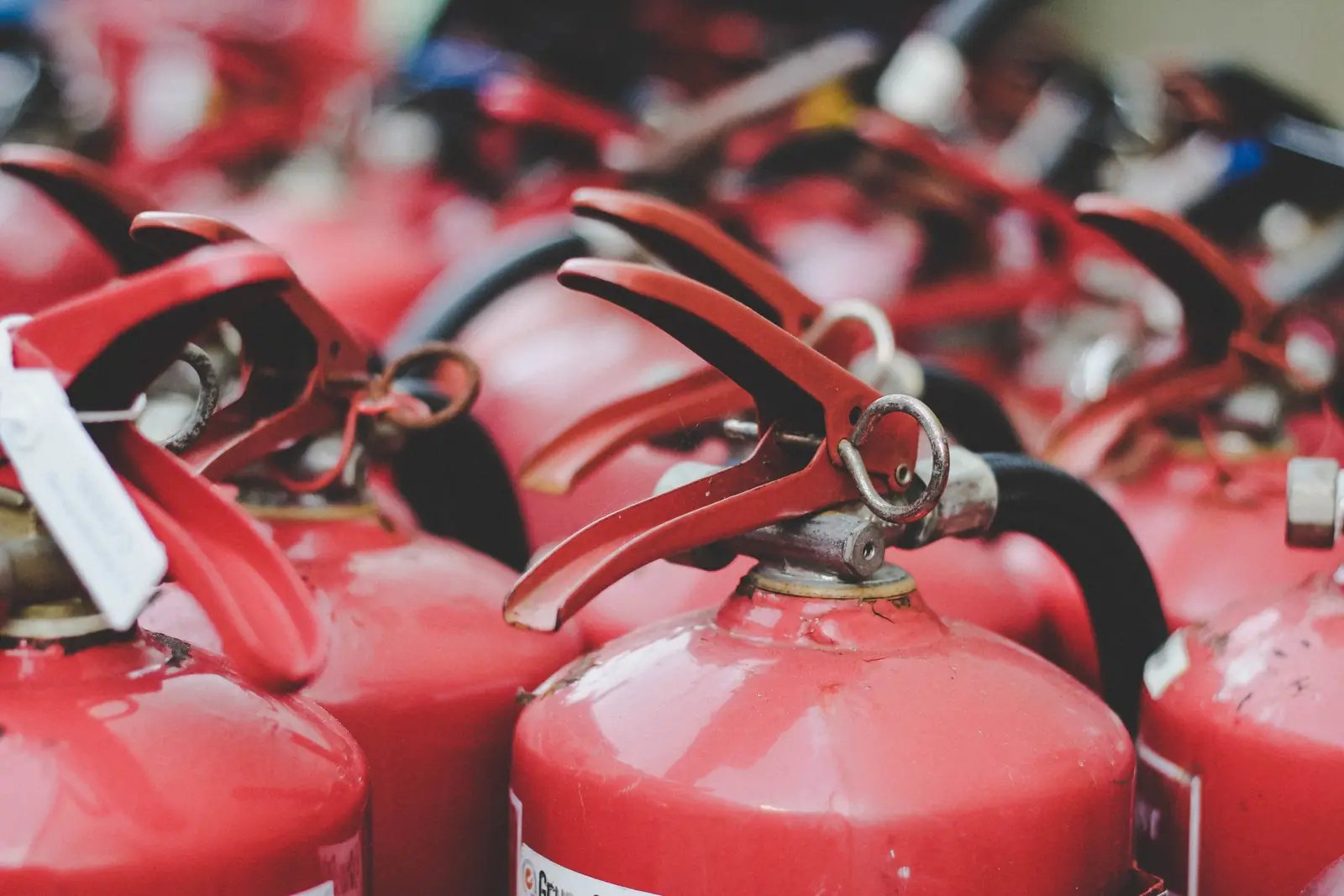
The red cylinder most people picture. Dry chemical units rated for Class A (ordinary combustibles like wood and paper), Class B (flammable liquids), and Class C (electrical fires). Appropriate for offices, retail spaces, warehouses, and most commercial environments.
Class K (Wet Chemical) — Commercial Kitchens
If you run a restaurant, café, food court kiosk, or any kitchen with commercial cooking equipment, you need a Class K extinguisher. Non-negotiable under Ontario law and NFPA 96. Standard ABC extinguishers will not suppress a cooking oil fire — the dry chemical can cause burning oil to splatter and spread. Class K units use a wet chemical that saponifies cooking grease, knocking the fire down fast.
Important: The Class K extinguisher must be mounted within 30 feet of the cooking equipment and must be accompanied by a working kitchen hood suppression system (NFPA 96). One without the other doesn't satisfy code.
CO₂ Extinguishers — Server Rooms and Electrical Areas
CO₂ units leave no residue, making them right for server rooms, data centres, medical equipment areas, and precision electronics. In a server room, a dry chemical extinguisher that actually works would still cause tens of thousands in damage from the residue alone.
Clean Agent — Archives and Sensitive Environments
Clean agent systems are used where both fire suppression and zero collateral damage are required — labs, museums, and archival storage being common applications.
The Four Things That Actually Fail Ontario Extinguisher Inspections
Based on what our technicians see weekly across GTA commercial properties, the four most common failure points are:
- Expired certification tag. The annual inspection wasn't done, or was done by someone unqualified and undocumented. The most common single failure — and the most preventable.
- Wrong extinguisher class for the risk area. A Class ABC unit in a commercial kitchen, or no Class K unit visible near cooking equipment.
- Blocked or inaccessible placement. The extinguisher is there but it's behind a shelf, in a storage room, or signage is missing so it's not identifiable from across the space.
- Low pressure gauge. The unit has been partially discharged or has leaked. The gauge is in the red and nobody noticed during monthly checks. A discharged extinguisher has zero firefighting capability.
What Non-Compliance Actually Costs
Businesses ask what the annual inspection costs. The right question is what non-compliance costs. In Ontario, a failed fire inspection can trigger:
- An order to comply with a deadline — non-compliance beyond the deadline triggers escalating fines
- Insurance denial — if a fire occurs and your equipment was non-compliant at the time, your carrier can deny the claim
- Business closure orders — in cases of serious non-compliance, the fire marshal can order the premises closed
- Personal liability — for property managers and building owners, documented non-compliance shifts liability to the individual
The annual inspection by a qualified technician is not a large expense. The cost of a failed inspection — remediation, re-inspection fees, fines, and operational disruption — is always larger.
How Boss Fire Handles This For You
Our NFPA 10-certified technicians perform the full annual inspection, internal maintenance at the 6-year mark, and hydrostatic testing at the 12-year cycle. Every unit we certify receives a new tamper seal, a dated certification tag, and documentation you can show your insurer or fire marshal on request.
Learn more about our fire extinguisher inspection and service. We set up automated reminders for every recurring cycle so you never have to track it yourself. One call books the inspection. You stay compliant. We serve all extinguisher classes across every commercial property type in the GTA.
Sources and references
- Ontario Fire Code, O. Reg. 213/07, Division B, Article 6.2.7.1 (portable extinguishers)
- NFPA 10, Standard for Portable Fire Extinguishers
- NFPA 96, Standard for Ventilation Control and Fire Protection of Commercial Cooking Operations
Frequently Asked Questions
How often do commercial fire extinguishers need to be inspected in Ontario? +
Under NFPA 10, commercial fire extinguishers require a monthly visual inspection by the property owner, plus a full annual inspection and certification by a qualified technician. Every 6 years they require internal maintenance, and every 12 years hydrostatic testing.
What type of fire extinguisher do I need for a commercial kitchen in Ontario? +
Commercial kitchens must have a Class K (wet chemical) fire extinguisher near the cooking equipment, required alongside the kitchen hood suppression system under NFPA 10 and NFPA 96. Standard ABC extinguishers are insufficient and non-compliant in commercial kitchen environments.
What happens if my fire extinguisher fails an inspection in Ontario? +
A failed fire extinguisher inspection can result in non-compliance with Ontario's Fire Code, potential insurance claim denials, fines from the fire marshal, and in serious cases, business shutdown orders. The extinguisher must be repaired, recharged, or replaced immediately to restore compliance.
Can I do my own fire extinguisher inspection in Ontario? +
Property owners can perform monthly visual checks confirming the unit is visible, accessible, pin is in place, and gauge reads in the green. However, the annual inspection and certification must be performed by a qualified technician certified to NFPA 10 standards and documented with a tag on the unit.
How much does fire extinguisher inspection cost in the GTA? +
Costs vary based on the number of units, their type, and whether recharging or maintenance is required. Contact Boss Fire at 905-519-2677 for a free, itemized quote for your property.
Need a Fire Safety Assessment?
Our certified technicians handle the full inspection cycle. Same-day service available across the GTA.