
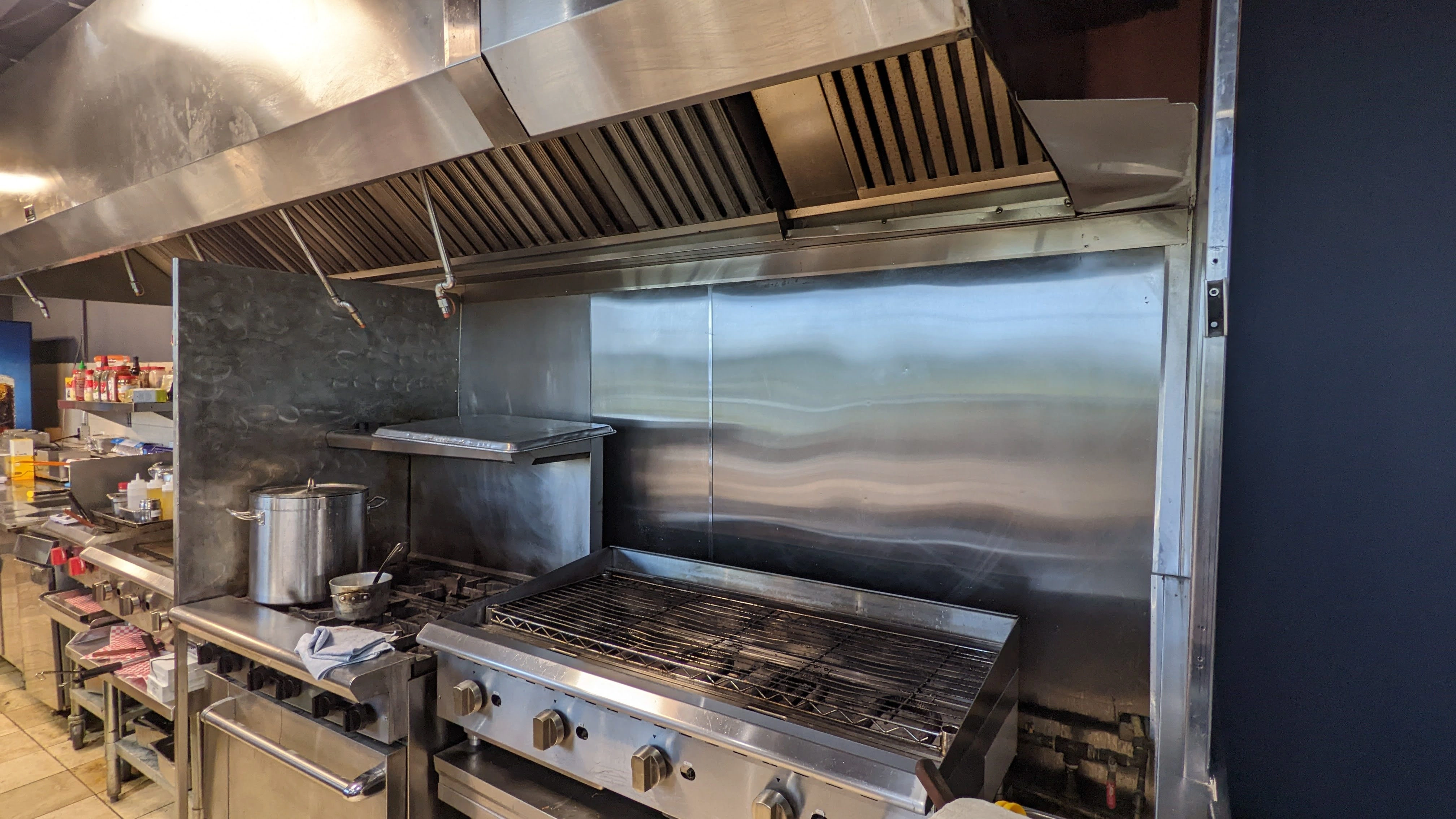
Kitchen Hood Fire Suppression Inspection & Service
Kitchen Hood
Suppression.
NFPA 96 commercial kitchen hood fire suppression. Installation, bi-annual inspection, and emergency service for restaurants across the GTA. We service Ansul and all other major kitchen suppression systems.
Protect your kitchen. Protect your insurance. Protect your business.
A commercial kitchen is the highest-risk fire environment in most commercial properties. Cooking oils reach autoignition temperatures that water and dry-chemical extinguishers simply can't control. That's why NFPA 96 requires a wet-chemical (K-Class) suppression system over every piece of cooking equipment. And why it must be inspected and tested twice per year.
Boss Fire services Ansul and all other major kitchen suppression systems and handles the complete lifecycle: new system design & installation, bi-annual inspection and testing, tank recharging after discharge, nozzle replacement, and fusible-link servicing.
Failed inspection? Insurance audit? Pre-opening inspection? Same-day service available across the GTA.
Kitchen Suppression Services
- New-build system design & installation
- Bi-annual inspection (every 6 months) per NFPA 96
- Fusible link replacement (required semi-annually)
- Nozzle inspection, cleaning, and replacement
- Wet-chemical tank recharging after discharge
- Manual pull station & gas shut-off verification
- Integration with building fire alarm system
- K-Class portable extinguishers (required within 30 ft of cooking)
- Hood & duct cleaning coordination
- Written inspection report for insurer & health department

Kitchen suppression for
every food business.
Full-Service Restaurant
Suppression for grills, fryers, ranges, salamanders, ovens. Full integration with building alarm.
Quick-Service (QSR)
Purpose-built for chain QSRs. Standardized across multiple locations via National Accounts.
Commercial Hood
Standard suppression nozzle layout over all cooking equipment under a single exhaust hood.
Mobile Food Trucks
NFPA 96 also applies to mobile food vending. We install and inspect truck-specific systems.
Ghost Kitchens
Multi-tenant kitchen facilities require dedicated suppression per tenant. We design and certify accordingly.
Emergency Service
Same-day response to discharged systems or failed inspections. We recharge, reset, and re-certify on site.
How often kitchen suppression
systems are serviced.
Commercial cooking operations in Ontario fall under NFPA 96, which the Ontario Fire Code references. Hood cleaning and suppression service are separate requirements, and passing one does not satisfy the other.
| Frequency | What happens | Who does it |
|---|---|---|
| Monthly | Visual check: manual pull station clear, nozzle caps in place, gauge in range, no signs of tampering. | Kitchen staff |
| Every 6 months | Full suppression system inspection and service: nozzles, detection and fusible links, agent cylinder, manual pull station, fuel and power shut-off, alarm connection. | Qualified technician |
| Every 12 years | Hydrostatic test of the wet chemical agent cylinders. | Qualified technician |
| Monthly to annually | Hood, duct and fan cleaning, based on cooking volume (monthly for solid fuel, quarterly for high volume, semi-annually for moderate, annually for low). | Hood cleaning contractor |
| Monthly and annually | Class K portable extinguisher: monthly visual check and annual service. | Staff, then qualified technician |
Sources: Ontario Fire Code, O. Reg. 213/07, Division B, Article 2.6.1.12; NFPA 96 (commercial cooking operations); NFPA 17A (wet chemical systems). Current to the amendments in force January 1, 2026. Last updated .
Related guides
Kitchen suppression service across the GTA
How often does a kitchen hood suppression system need to be inspected? +
Under NFPA 96, commercial kitchen hood suppression systems require inspection every 6 months by a qualified technician. During each inspection, the fusible links must be replaced, the nozzles checked and cleaned, and the system's manual pull station and gas shut-off tested. Missed inspections typically void insurance coverage.
What's the difference between the hood cleaning and the suppression inspection? +
Hood cleaning removes grease buildup from the hood, ducts, and fans. Typically required every 1-3 months depending on volume. Suppression inspection is the semi-annual servicing of the fire-extinguishing system above the hood. Boss Fire handles the suppression side and can coordinate with your hood-cleaning provider.
Do I need a K-Class portable extinguisher in addition to the hood suppression? +
Yes. NFPA 10 requires a portable K-Class (wet chemical) fire extinguisher within 30 feet of any commercial cooking equipment, regardless of the hood suppression system. This is a frequently-failed inspection item.
What happens if our hood suppression system discharges? +
The system must be professionally recharged, nozzles and fusible links must be replaced, and the system must be re-certified before the kitchen can reopen. Boss Fire offers same-day emergency discharge service across the GTA. Call 905-519-BOSS.
Book a kitchen suppression
inspection in the GTA.
Free on-site assessment across the GTA. No charge, no pressure. Just a clear plan and a single point of contact for every fire system on site.