
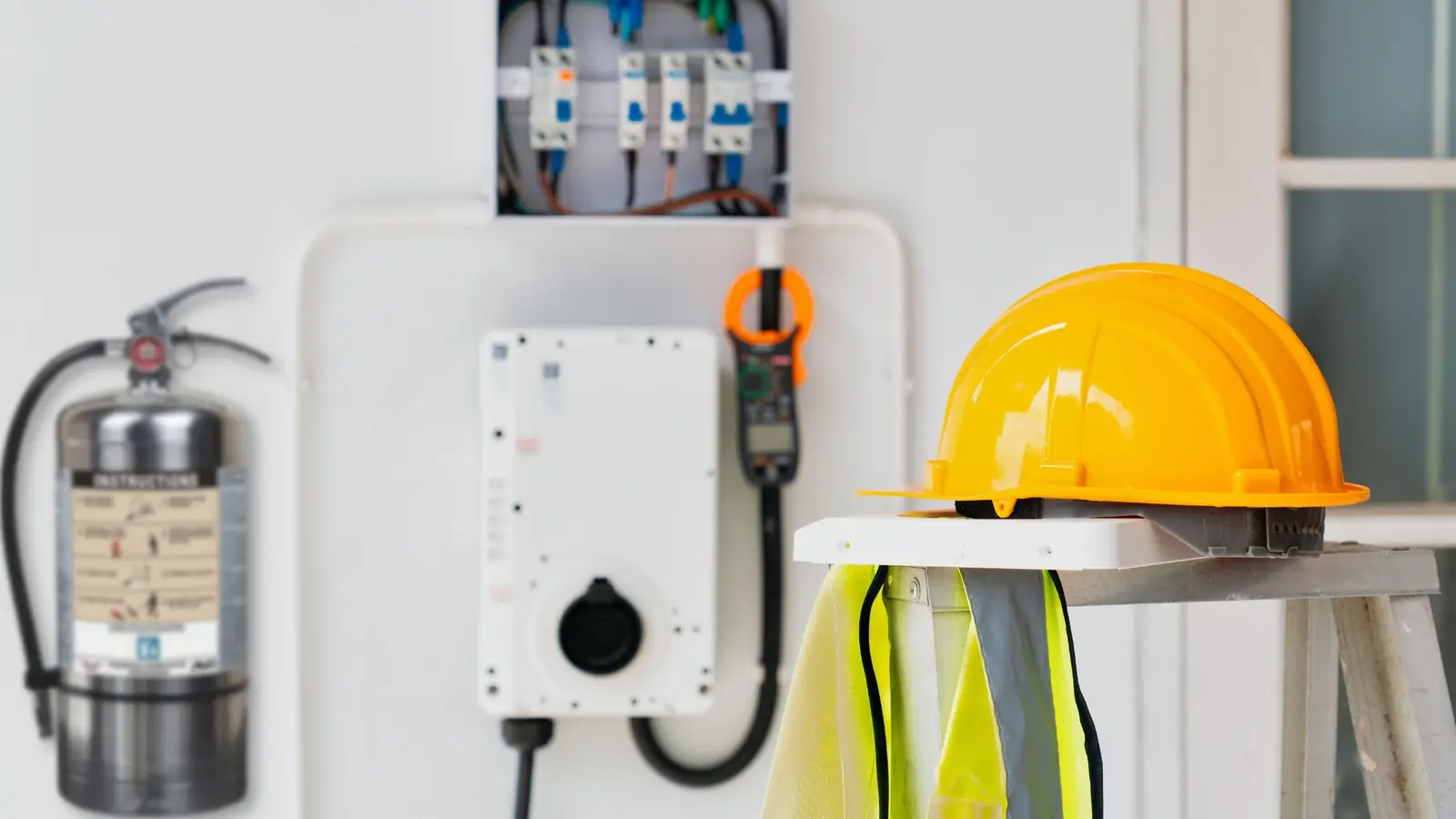
Most buildings have more lithium-ion batteries than they did five years ago, and almost nobody has reassessed their extinguisher coverage since. Call or Email us to order your AVD Extinguishers today.
Your building probably has more lithium-ion batteries in it than it did five years ago. Electric forklifts and pallet jacks. Scissor lifts. Cordless tool charging stations. E-bikes and e-scooters in the parking garage. Battery backup for servers. If you run a warehouse, a distribution center, or a fleet yard anywhere in the GTA, the number has climbed quietly and nobody reassessed the extinguishers on the wall.
That matters, because a lithium-ion battery fire does not behave like the fires your existing extinguishers were built for.
Why a Battery Fire Is a Different Problem
Most fires need three things: fuel, heat, and oxygen. Take one away and the fire stops. Every conventional extinguisher works on that principle. Dry chemical interrupts the chemical reaction. CO2 displaces oxygen. Water and foam remove heat.
A lithium-ion cell in thermal runaway does not follow those rules. Once a cell is damaged, overcharged, overheated, or defective from the factory, it begins an internal chemical reaction that generates its own heat and releases its own flammable gases. The reaction is self-sustaining. It does not need the air around it to continue.
Worse, heat from one failing cell transfers to the cells packed next to it, pushing them into runaway as well. That chain reaction is called propagation, and it is why a battery fire that looks small can become a serious fire several minutes later.
This also explains the reignition problem. Put out the visible flames on a battery pack and you have addressed the symptom. The cells inside may still be reacting. Fire services across North America have documented battery packs reigniting hours after an apparent knockdown.
Why Standard Extinguishers Fall Short
Each conventional agent fails for its own reason.
Dry chemical (ABC) interrupts the flame chemistry but provides almost no cooling. It also does not cling to the vertical surfaces of a battery cell. The flames go out, the cells keep reacting, and the fire returns.
CO2 displaces oxygen and cools slightly on discharge. A battery in thermal runaway generates oxygen internally, so oxygen displacement does very little. The cooling effect is too brief to matter.
Foam and wet chemical work by forming a film across a burning surface. Thermal runaway temperatures break that film down. The barrier does not survive.
Water is the most useful of the conventional options, because cooling is genuinely helpful here. The problem is volume. A portable water extinguisher runs dry long before it has removed enough heat from a battery pack, and the moment the water stops, nothing is left holding the reaction back.
What AVD Is
AVD stands for Aqueous Vermiculite Dispersion. It was developed specifically for lithium-ion battery fires, and it is the reason a new category of extinguisher now exists.
Vermiculite is a naturally occurring mineral, part of a group of hydrated magnesium, iron, and aluminum silicates that form in thin layered flakes. It is chemically inert, non-toxic, and has been used as a thermal insulator for decades. When vermiculite is chemically processed, it separates into microscopic platelets that can be held in suspension in water.
That suspension is AVD. The agent is roughly 83 percent water and 17 percent dispersed vermiculite, discharged as a fine mist rather than a jet.
How AVD Works
AVD attacks the problem from two directions at once, which is what separates it from every conventional agent.
The water cools. Discharged as a mist, the water content pulls heat out of the burning cells quickly, which is the single most useful thing any agent can do to a battery in thermal runaway.
The vermiculite insulates. As the water evaporates, the vermiculite platelets settle onto the surface of each cell and build into a coating. Because the platelets are flat and overlap, they form a continuous thermal barrier. That barrier does two jobs: it blocks heat transfer from a burning cell to the cells beside it, which stops propagation, and it stays in place after the water is gone, which is what reduces the chance of reignition.
That second half is the part no conventional agent provides. Cooling without a barrier buys you time. Cooling plus a barrier addresses the mechanism.
What AVD Is Tested To
This is worth understanding, because the standards landscape for battery extinguishers is still developing and the marketing around it moves faster than the certification does.
There is no long-established portable extinguisher rating for lithium-ion battery fires in the way there is a Class A rating or a Class K rating. What exists instead is a test protocol called NTA 8133, a Dutch standard developed to evaluate how an extinguishing agent performs against a lithium-ion battery in thermal runaway. Reputable AVD units are tested to that protocol.
Separately, AVD extinguishers carry conventional listings for the fire classes they are rated on. Several portable AVD units are UL listed for Class A performance, which is the fire class covering ordinary combustibles.
So when you evaluate an AVD unit, look for two things: a recognized listing for its conventional fire class rating, and documented lithium-ion testing under NTA 8133 or an equivalent protocol. A product that claims battery performance without naming the protocol it was tested to has not told you anything.
Where AVD Belongs in a Commercial Building
AVD is not a replacement for your existing extinguishers. It is an addition wherever batteries are concentrated. The clearest cases across the GTA:
Forklift and equipment charging areas. This is the highest-value location in most warehouses. Chargers run unattended, often overnight, and a battery failure at a charging station has fuel and time on its side.
Fleet and vehicle bays. Electric and hybrid vehicles, plus the battery tools and equipment stored alongside them.
Server rooms and telecom closets with battery backup. These spaces usually have clean agent protection already, which is correct for the electronics. It is not correct for the battery bank.
E-bike and e-scooter storage. Parking garages, bike rooms, and delivery fleet depots. Consumer-grade batteries charged on consumer-grade chargers are a documented and growing ignition source.
Battery energy storage systems. Any BESS installation, which comes with its own protection requirements beyond portables. See our battery storage (BESS) fire protection service.
Retail and warehouse areas storing battery stock. Volume changes the risk profile even when individual units are small.
What This Does Not Change
Your existing obligations stay exactly where they were. The Ontario Fire Code and NFPA 10 still govern your portable extinguisher program. Adding AVD units does not reduce your Class A, B, C, or K coverage requirements, and AVD units fall under the same inspection and maintenance rules as everything else on your wall: a monthly visual check and an annual inspection by a certified technician (full inspection schedule).
What it does change is whether you have anything on site that will actually work on the fire you are most likely to have in a charging bay.
Getting the Assessment Right
The practical question is not whether AVD is effective. The testing supports that. The practical question is where your battery concentrations actually are, and almost nobody has mapped that recently.
A walkthrough answers it quickly. Our technicians will identify battery concentrations across your property, confirm whether your current extinguisher coverage addresses them, and tell you plainly where an AVD unit is warranted and where it is not.
Boss Fire Inc. has served commercial and industrial properties across the Greater Toronto Area since 2016. NFPA certified technicians, fully insured to $5 million, same day service available.
Call 905-519-2677 or request your free site assessment.
Sources and references
- Ontario Fire Code, O. Reg. 213/07
- NFPA 10, Standard for Portable Fire Extinguishers
- NFPA 855, Standard for the Installation of Stationary Energy Storage Systems
- NTA 8133, Dutch test protocol for extinguishing agents on lithium-ion battery fires (published by NEN)
Frequently Asked Questions
What does AVD stand for in fire extinguishers? +
AVD stands for Aqueous Vermiculite Dispersion. It is an extinguishing agent made of microscopic vermiculite platelets suspended in water, roughly 83 percent water and 17 percent vermiculite. It is discharged as a fine mist and was developed specifically for lithium-ion battery fires, where conventional agents such as dry chemical and CO2 do not address the underlying reaction.
Why do lithium-ion battery fires need a special extinguisher? +
A lithium-ion cell in thermal runaway produces its own heat and its own flammable gases, so it does not depend on surrounding oxygen to keep burning. Dry chemical and CO2 interrupt flames but provide almost no cooling, so the cells continue reacting and the fire returns. Heat also spreads to adjacent cells, which is why battery fires grow.
Can I use a regular ABC extinguisher on a lithium-ion battery fire? +
An ABC dry chemical unit may knock down visible flames, but it does not cool the cells or stop heat transferring between them. The battery can reignite hours or even days later. If an ABC unit is all you have, use it and evacuate, but it should not be the planned protection for an area where batteries are charged or stored.
What standard are AVD extinguishers tested to? +
There is no long-established portable extinguisher class rating for lithium-ion battery fires. Reputable AVD units are tested under NTA 8133, a protocol developed to measure agent performance against batteries in thermal runaway, and they also carry conventional listings for their rated fire classes. Ask any supplier to name the protocol their product was tested to.
Where should a business install AVD extinguishers? +
Anywhere lithium-ion batteries are concentrated. The highest-value locations are forklift and equipment charging areas, fleet and vehicle bays, server rooms with battery backup, e-bike or e-scooter storage, and any area holding battery stock in volume. AVD supplements your existing extinguishers rather than replacing them, so your Class A, B, C, and K coverage stays in place.
Need a Fire Safety Assessment?
Our certified technicians handle the full inspection cycle. Same-day service available across the GTA.