
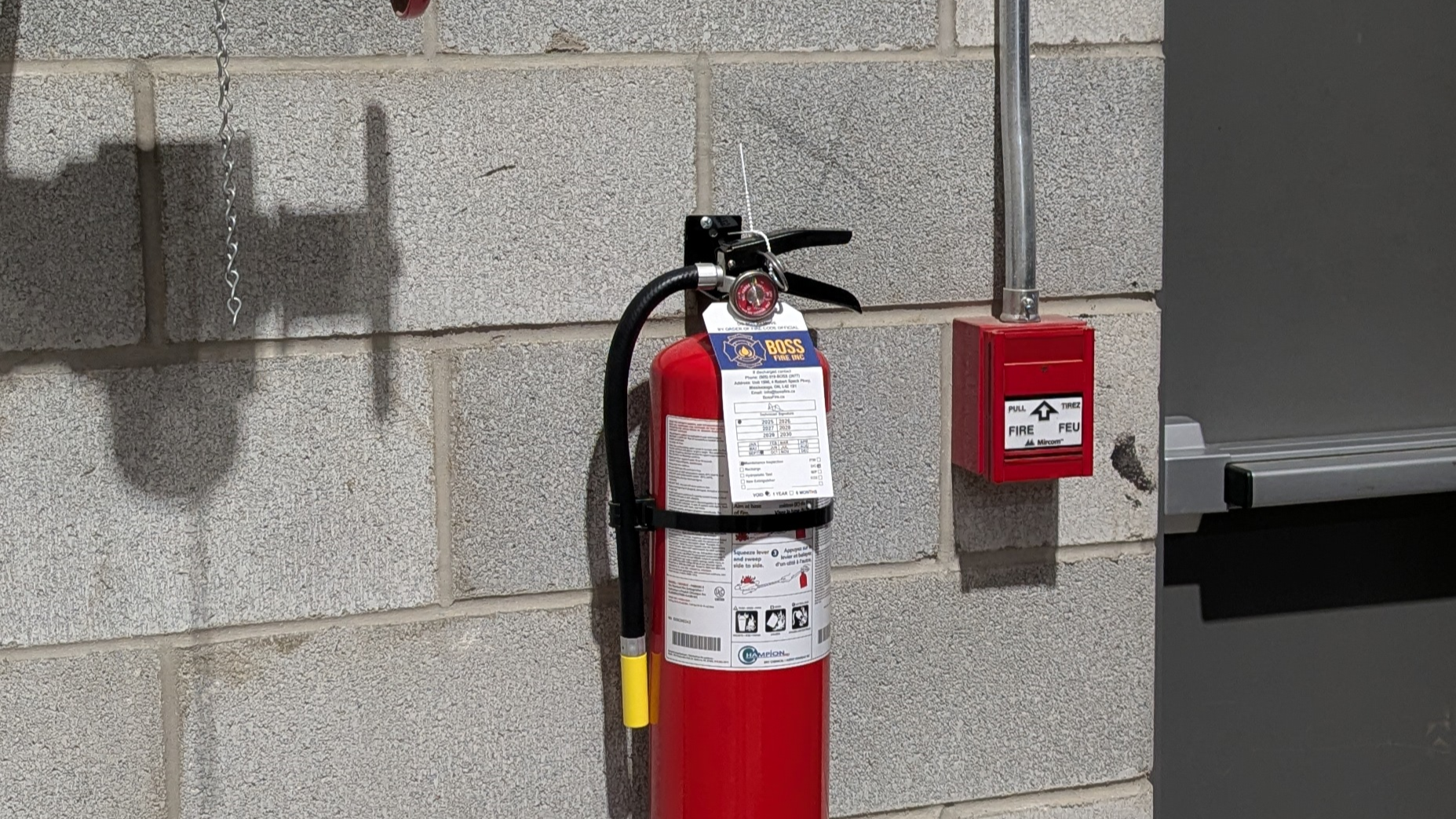
NFPA 10 requires all commercial fire extinguishers to be inspected annually by a certified technician. A monthly visual check by the property owner does not satisfy the annual inspection requirement under Ontario's Fire Code.
The short answer: monthly, annually, every 6 years, and every 12 years. Each level has a different scope, a different person responsible for it, and different consequences if it gets skipped. Ontario's Fire Code ties directly to NFPA 10 — the National Fire Protection Association's standard for portable fire extinguishers — so this schedule isn't a suggestion. It's the law.
Most Ontario businesses know they're supposed to have their extinguishers inspected "at some point." Fewer know there are four distinct inspection requirements with different rules about who can perform them. That gap is where most compliance failures happen.
The Four Inspection Levels Under NFPA 10
NFPA 10 establishes a tiered inspection and maintenance program for portable fire extinguishers. The Ontario Fire Code adopts NFPA 10 as its benchmark (Division B, Article 6.2.7.1), which means when a fire inspector checks your extinguishers, this is the schedule they're measuring you against.
Each level builds on the one before it. A unit that passes its monthly visual check and annual inspection still needs internal maintenance at the 6-year mark — even if it has never been discharged. Age and environmental exposure degrade internal components regardless of use.
The Monthly Visual Inspection
This one you can do yourself. NFPA 10 requires a monthly visual inspection of every portable fire extinguisher on your premises. It takes about 30 seconds per unit and the standard is straightforward: the extinguisher should be where it's supposed to be, you should be able to get to it, and it should look like it's ready to work.
Specifically, you're confirming:
- The unit is in its designated, mounted location — not moved to a storage room or behind furniture
- The operating area is clear and the extinguisher is immediately accessible
- The pressure gauge needle is in the green zone (not the red)
- The pull pin is in place and the tamper seal is intact
- There is no visible corrosion, dents, or physical damage to the cylinder or nozzle
- The discharge nozzle or hose is unobstructed
- The inspection tag from the most recent annual certification is present
These checks must be documented. Keep a log — date, who checked it, what was observed. That record is what you show a fire inspector when they ask whether your monthly checks are being done. A verbal "yes" is not sufficient.
The Annual Inspection
This is the one that most businesses treat as the only inspection — and the one they most often let slip. The annual inspection must be performed by a qualified technician with NFPA 10 certification. A business owner checking their own extinguisher, even carefully and thoroughly, does not satisfy this requirement under Ontario's Fire Code.
During the annual inspection, a certified technician works through a full mechanical checklist:
- Pressure gauge reading — confirmed in operating range
- Cylinder exterior — checked for corrosion, pitting, dents, and heat damage
- Discharge nozzle and hose — cleared and confirmed unobstructed
- Pull pin and locking mechanism — tested for proper function
- Operating handle — inspected for damage or deformation
- Tamper seal — replaced with a new, intact seal
- Extinguisher class — confirmed correct for the fire risk in that location (which class goes where)
- Certification tag — new tag affixed showing technician name, company, date of inspection, and any work performed
The tag matters. Under NFPA 10, the certification tag must include the technician's name, the company performing the service, and the date. A tag without this information is non-compliant even if the unit itself passed the check. Fire inspectors look at the tag first.
The 6-Year Internal Maintenance
This one surprises most business owners. At the 6-year mark from the last internal maintenance date, the extinguisher must be taken out of service and fully disassembled. Internal components — o-rings, springs, valves — degrade over time regardless of whether the unit has ever been used. The 6-year maintenance addresses that.
The process involves emptying the unit completely, disassembling the valve mechanism, inspecting and replacing worn internal components, checking the cylinder interior, reassembling, and recharging with fresh agent. The unit is then re-pressurized, resealed, and returned to service with an updated maintenance label.
Skipping the 6-year maintenance doesn't necessarily mean a unit looks wrong on the outside. The pressure gauge can read green while internal components have degraded past the point of reliable function. This is why NFPA 10 requires it on a fixed schedule rather than leaving it to visual assessment.
The 12-Year Hydrostatic Test
At the 12-year point, the cylinder itself gets tested. Twelve years applies to stored-pressure dry chemical extinguishers, the most common type; CO₂, water, foam and wet chemical (Class K) extinguishers are hydrostatically tested every five years. Hydrostatic testing fills the unit with water and pressurizes it beyond its rated operating pressure to check whether the metal has weakened enough to pose a rupture risk. A cylinder that fails hydrostatic testing must be removed from service and destroyed — it cannot be repaired or returned to use.
The 12-year interval assumes the unit has been maintained correctly throughout that period. A unit that has been discharged and not recharged, damaged and not removed from service, or has visible corrosion may need hydrostatic testing earlier than the 12-year mark.
What Recharging Means — and When It's Required
Recharging replaces the extinguishing agent and restores the unit to full operating pressure. It's required after any discharge — partial or complete. This catches more businesses than you'd expect: an extinguisher that was briefly triggered to check how it works, or used to put out a small fire and then returned to its bracket, is now a cylinder with partial or no firefighting capacity. It looks the same from across the room.
Recharging is also required when internal maintenance finds agent degradation or when pressure readings indicate loss. It is done on-site or at a service facility and must be performed by a qualified technician using the correct agent type for that extinguisher class.
Which Ontario Businesses This Applies To
If your premises are classified as a commercial or industrial occupancy under the Ontario Building Code — which covers restaurants, retail, offices, warehouses, industrial facilities, medical offices, gyms, and essentially every commercial space — this schedule applies to you.
Residential buildings with common areas, commercial condominiums, and mixed-use properties also fall under commercial inspection requirements for any common or non-residential space. If you're unsure whether your specific occupancy type has additional or modified requirements, a site assessment by an NFPA-certified technician will give you a clear picture without any guesswork.
What Happens When the Schedule Slips
In Ontario, non-compliance with fire extinguisher inspection requirements is taken seriously. A fire inspector who finds extinguishers without valid annual certification tags will issue a non-compliance order. From that point:
- You have a fixed deadline to achieve compliance and document it
- Missing that deadline triggers escalating fines under the Ontario Fire Code
- If a fire occurs during the non-compliance period, your insurer can deny the claim on the basis that required safety equipment was not maintained
- In cases of serious or repeated non-compliance, the fire marshal has authority to issue a business closure order
The annual inspection by a qualified technician is not a significant expense. The remediation cost — catching up on missed cycles, re-inspection fees, potential fines, and the operational disruption of a compliance order — is always larger. The cost of an insurance denial after a fire is larger still.
How Boss Fire Handles This For Your Business
Our NFPA 10-certified technicians cover the full inspection cycle — monthly check documentation templates, annual inspections with certified tagging, 6-year internal maintenance, and 12-year hydrostatic testing. Every unit we service receives a new tamper seal, a complete certification tag, and a service record you can produce on request for your insurer or the fire marshal.
See our fire extinguisher inspection and service page for what a visit includes. We track your inspection schedule for you. When your next annual inspection is due, we reach out — you don't have to manage the calendar. We serve all commercial extinguisher classes across every occupancy type in the GTA, from convenience stores and restaurants to warehouses and multi-location national accounts.
Sources and references
- Ontario Fire Code, O. Reg. 213/07, Division B, Article 6.2.7.1 (portable extinguishers)
- NFPA 10, Standard for Portable Fire Extinguishers
Frequently Asked Questions
How often should a fire extinguisher be inspected in Ontario? +
Under NFPA 10 and the Ontario Fire Code, commercial fire extinguishers require four levels of inspection: a monthly visual check by the property owner; a full annual inspection by a qualified NFPA-certified technician; internal maintenance every 6 years; and hydrostatic pressure testing every 12 years.
What is checked during an annual fire extinguisher inspection? +
A certified technician checks pressure gauge readings, inspects the cylinder for corrosion and damage, tests the pull pin and tamper seal, verifies the discharge nozzle is clear, confirms the correct extinguisher class for the risk area, replaces the tamper seal, and attaches a new dated certification tag with their name and company.
Who can perform a fire extinguisher inspection in Ontario? +
Monthly visual checks can be performed by the property owner or a designated employee. The annual inspection, 6-year internal maintenance, and 12-year hydrostatic test must be performed by a qualified technician with NFPA 10 certification. A business owner conducting their own annual inspection does not satisfy the Ontario Fire Code requirement.
What happens if a fire extinguisher fails its annual inspection? +
A non-compliant extinguisher must be immediately removed from service and repaired, recharged, or replaced. Non-compliance can result in failed fire inspections, fines from the Ontario fire marshal, insurance claim denials if a fire occurs, and in serious cases, business closure orders.
What does a fire extinguisher inspection cost in the GTA? +
Annual inspection costs vary based on the number of units, extinguisher type, and whether recharging or maintenance is required. Contact Boss Fire at 905-519-2677 for a free itemized quote for your property.
Need a Fire Safety Assessment?
Our certified technicians handle the full inspection cycle. Same-day service available across the GTA.