
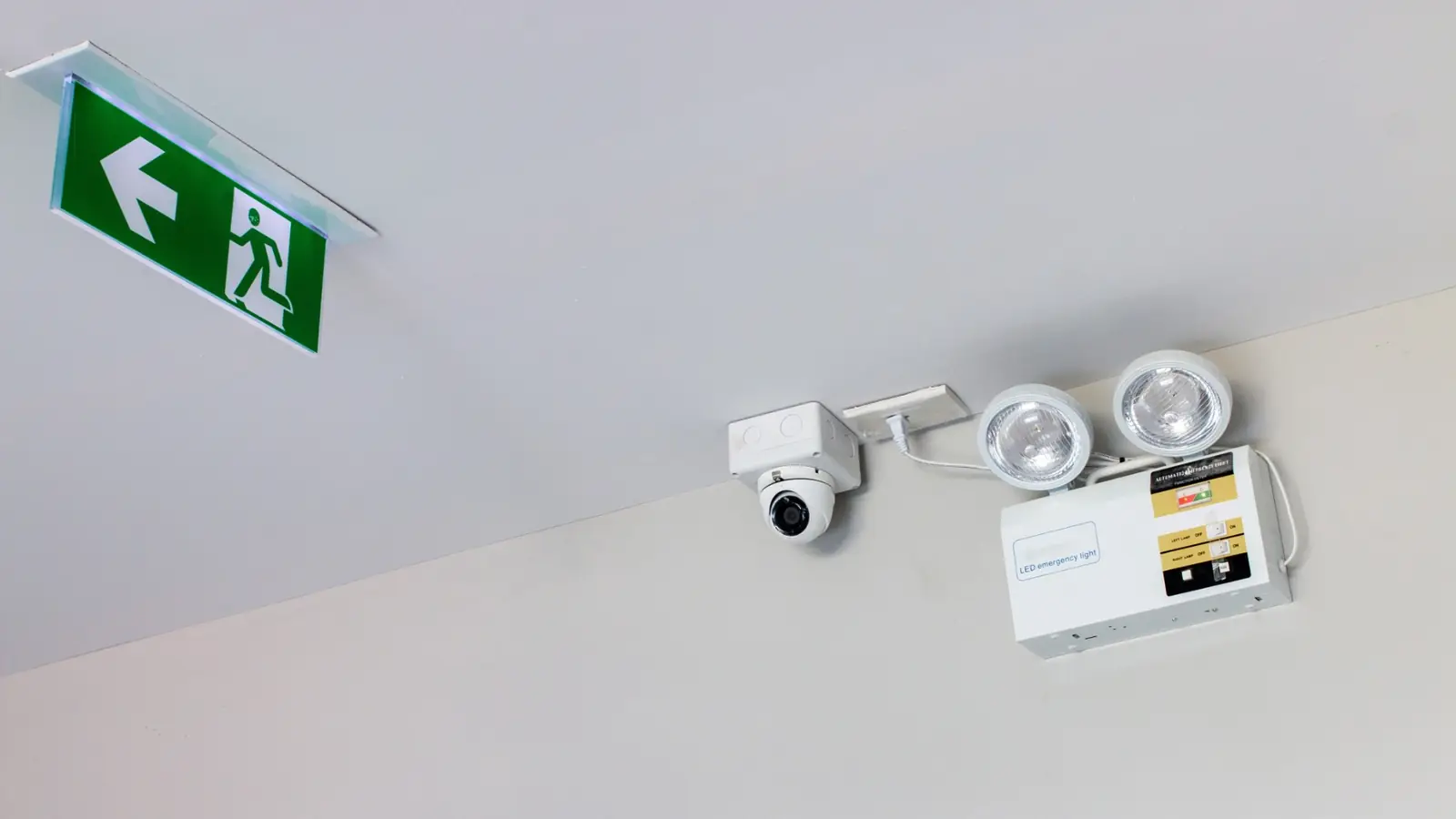
Ontario's emergency lighting test schedule moved on January 1, 2026. It now sits in Fire Code Articles 6.7.1.6 to 6.7.1.8, so update any log sheet that still cites Article 2.7.3.3.
The Ontario Fire Code requires battery emergency lights to be inspected and tested every month, and to run for their full design duration under a simulated power failure at least once every 12 months. After that annual test, the charging system has to be checked against the manufacturer's specifications. Exit signs with battery backup follow the same monthly and yearly pattern.
These rules sit in Articles 6.7.1.6 to 6.7.1.8 of Division B of the Fire Code. If your log sheet cites Article 2.7.3.3, it predates January 1, 2026, when the Fire Code amendments in O. Reg. 87/25 took effect and moved the test schedule into Section 6.7. Article 2.7.3.3 now says only that emergency lighting and exit signs must be kept in operating condition in conformance with Section 6.7. Our post on the Ontario Fire Code 2026 changes covers the wider amendments.
What does the monthly emergency lighting check involve?
Article 6.7.1.6 covers self-contained unit equipment: the battery packs with lamp heads mounted in stairwells, corridors, and near exits. Once a month, someone has to inspect each unit and confirm that:
- The pilot light works and isn't damaged or covered
- The terminal connections are clean, free of corrosion, and lubricated when needed
- The terminal clamps are clean and tight to the manufacturer's specifications
- The battery surface is clean and dry
- The electrolyte level and specific gravity match the manufacturer's specifications
The same month, each unit needs a function test to show its lamps come on when normal power fails. The unit's test switch simulates the power failure, and the lamps should light on battery at once. A unit that stays dark, flickers, or lights only one head goes on the repair list.
Write each check down as you go: the date, the person who did it, and what they found. That log is what a fire inspector asks to see.
How does the annual full-duration test work?
At least once every 12 months, each unit has to run on battery, under simulated power failure, for its full design duration. A unit designed for 30 minutes has to stay lit for 30 minutes. A unit designed for an hour has to last the hour.
Article 6.7.1.6 then adds a step that's easy to skip. Once the duration test ends, the charging voltage, the charging current, and the recovery period get tested against the manufacturer's specifications. A battery that runs the full time but won't recharge properly can't carry the next outage.
Plan the annual test for a quiet time in the building. A unit that has just run its battery down needs its recovery period before it can cover another power failure, so testing during a busy day leaves you exposed.
How long your emergency lights must run
The Building Code sets the design duration when the building is designed. Under Article 3.2.7.4, emergency lighting has to last:
- 2 hours in high buildings covered by Subsection 3.2.6
- 1 hour in care, care and treatment, and detention occupancies (Group B), in retirement homes, and in certain other buildings the Code lists
- 30 minutes in all other buildings
Your annual test has to match the duration your building was designed for. If you don't know it, check the building's drawings or ask your technician before the test starts.
What about emergency lights on a central system?
Some buildings power their emergency lights from a central source instead of individual battery packs. Under Article 6.7.1.7, those lights have to be inspected at least every 12 months to confirm they work. If a central bank of batteries powers them, the batteries get the same monthly and annual inspections and tests as unit equipment.
Exit signs follow a similar schedule
Article 6.7.1.8 sets the inspection schedule for exit signs, and it depends on how the sign stays lit:
- Signs with battery backup: inspected monthly to confirm they stay visible when normal power fails, and at least every 12 months to confirm they stay visible for the full design duration
- Other powered signs: inspected at least every 12 months to confirm they stay visible when normal power fails
- Self-luminous and photoluminescent signs: maintained to the manufacturer's instructions and any conditions of their approval
Separate articles require every exit sign to be clearly visible, clean, and legible, and lit whenever the building is occupied. Our guide to exit sign requirements in Ontario covers green and red signs and the reasons signs fail their test.
Which records should you keep?
Article 1.1.2.2 requires inspection and test records to stay at the building for at least two years, and the most recent record and the one before it must always be on hand. A good emergency lighting log shows, for each unit:
- Its location or unit number
- The date of each monthly check and function test
- The date and length of the annual duration test
- The result of the charging check
- Any battery, lamp, or unit replacement
A fire inspector reading the log should be able to walk the building and match every line to a unit on the wall.
Why do emergency lights fail their test?
The Fire Code's monthly checklist points to most of the problems a test turns up:
- The battery no longer holds a charge for the full design duration
- A lamp or LED head doesn't light
- Corroded terminals or loose clamps stop the battery from charging or discharging properly
- The charger falls outside the manufacturer's voltage, current, or recovery specifications
- The pilot light is out, damaged, or covered
- A head has been knocked out of aim, or shelving, signage, or a renovation now blocks it
Many of these are small repairs: a new battery, a new lamp, cleaned terminals, or a head turned back toward the exit path. When the charger or the housing has failed, your technician will quote a replacement unit instead of a repair.
Who can do the monthly and annual tests?
The Fire Code sets the intervals for emergency lighting but doesn't name who has to do the work. Trained building staff can handle the monthly check and function test. The annual test takes more time and test equipment, because each unit has to run its full duration and then pass the charging check.
Fire alarm systems work differently. For annual fire alarm work, the Fire Code requires a person who has completed a course acceptable to the Fire Marshal. Our post on annual fire alarm inspection explains that requirement.
How much does an emergency lighting test cost?
Boss Fire doesn't publish a single emergency lighting price, because the total depends on how many units your building has and what they need. Every quote is itemized and answered the same business day.
Each visit carries one service call fee. If we inspect your fire extinguishers on the same visit, both jobs share that one fee. Our guide to fire extinguisher inspection cost explains how the fee and the per-unit price work.
Book your emergency lighting test with Boss Fire
Boss Fire tests and services emergency lighting and exit signs across the GTA and the surrounding region, from Niagara to Oshawa and north to Barrie. A technician based in Milton covers Halton and Peel, including Oakville. Our technicians are NFPA-certified, Boss Fire carries $5 million in liability insurance, and in the GTA we can be on site within 48 hours.
Book My Emergency Lighting Test
See our emergency lighting and exit sign service for what a visit covers, or work through the full Ontario fire inspection checklist before your next fire inspection.
Sources and references
- Ontario Fire Code, O. Reg. 213/07, Division B, Article 1.1.2.2 (how long records are kept)
- Ontario Fire Code, O. Reg. 213/07, Division B, Articles 2.7.3.1 to 2.7.3.3 (exit signs and emergency lighting) and 6.7.1.6 to 6.7.1.8 (unit equipment, emergency lights, and exit signs)
- O. Reg. 87/25, the Fire Code amendments in force January 1, 2026
- Ontario Building Code, O. Reg. 332/12, Division B, Article 3.2.7.4 (emergency lighting duration)
- 2024 Building Code Compendium, Part 3
Frequently Asked Questions
When should emergency lighting be checked in Ontario? +
The Ontario Fire Code requires battery emergency lighting units to be inspected and tested at least once a month, and to run for their full design duration under a simulated power failure at least once every 12 months. After the annual test, the charging voltage, charging current, and recovery period are checked against the manufacturer's specifications.
How long does emergency lighting have to last in Ontario? +
The Building Code sets the duration when a building is designed: 2 hours in high buildings, 1 hour in care, care and treatment, and detention occupancies, retirement homes, and certain other buildings the Code lists, and 30 minutes in other buildings. The annual test has to match the duration your building was designed for.
How much is an emergency lighting test? +
It depends on how many units your building has and what they need, so Boss Fire doesn't publish a single price. Every quote is itemized and answered the same business day. If we inspect your fire extinguishers on the same visit, both jobs share one service call fee.
Who can test emergency lighting in Ontario? +
The Fire Code sets the intervals for emergency lighting but doesn't name who has to do the work. Trained building staff can handle the monthly check and test. The annual full-duration test and charging check take more time and test equipment.
What records do I need to keep for emergency lighting? +
Keep each inspection and test record at the building for at least two years, and always keep the most recent record and the one before it. A useful log lists each unit by location, the date of every monthly check, the annual duration test result, the charging check, and any repairs.
Need a Fire Safety Assessment?
Our certified technicians handle the full inspection cycle. Same-day service available across the GTA.