
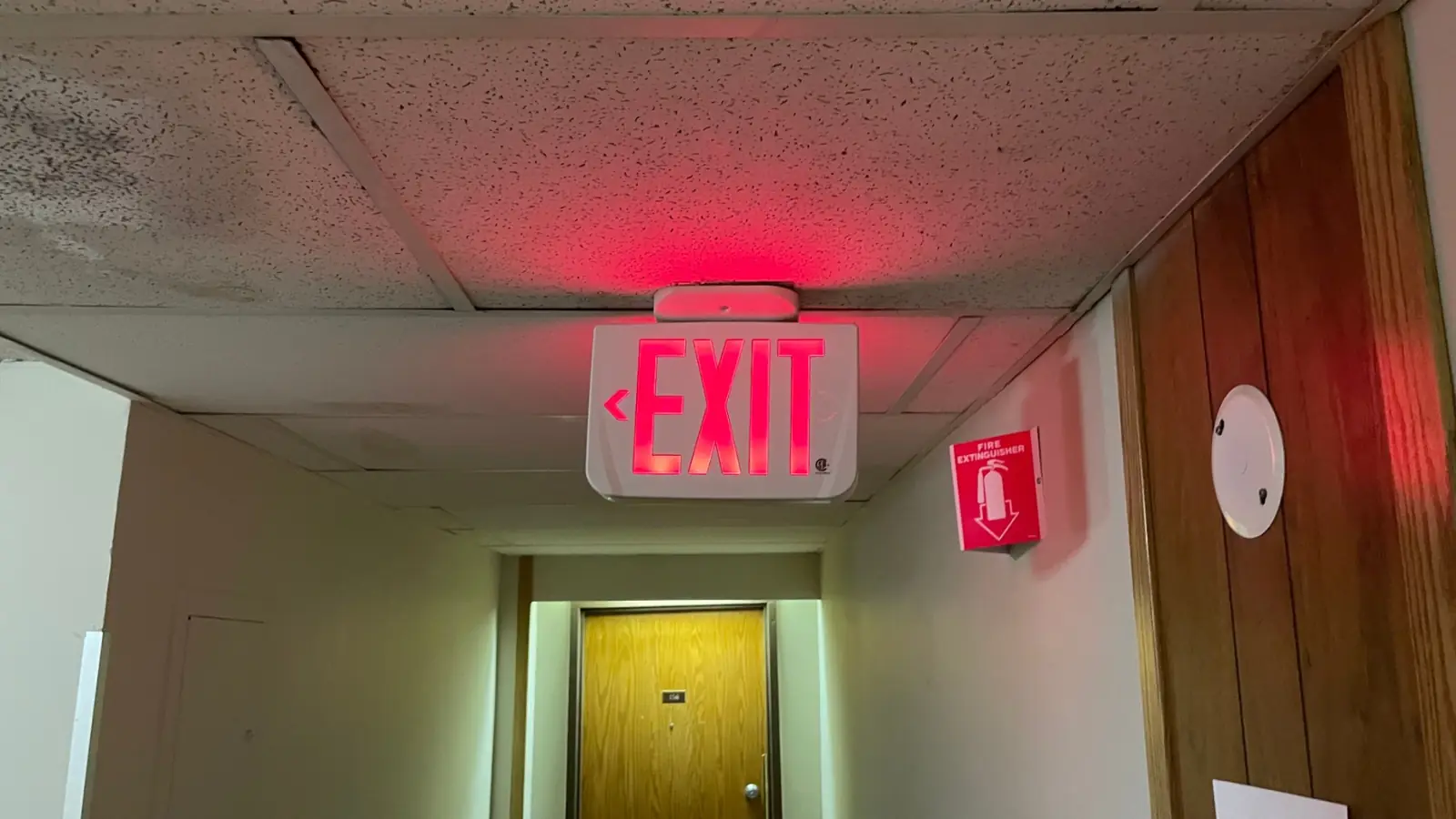
The Fire Code doesn't require you to replace a working red EXIT sign. Renovation work under a building permit can bring in the green running man rule, so ask your fire department before you replace or renovate.
Since January 1, 2014, the Ontario Building Code has required the green and white running man pictogram on exit signs in buildings built or renovated under a permit applied for on or after that date. The Fire Code has no article that makes you replace a working red EXIT sign. It does require every exit sign to stay visible, clean, legible, and lit while the building is occupied, and to pass its scheduled inspections.
Two codes share the job. The Building Code decides how a sign must look and where it goes when a building is designed or renovated. The Fire Code decides how you keep it working once the building is in use.
When did Ontario switch to green running man exit signs?
Article 3.4.5.1 of the 2012 Building Code (O. Reg. 332/12) requires exit signs to show a green and white pictogram that follows the ISO 3864-1 and ISO 7010 standards. The requirement took effect on January 1, 2014. Projects whose building permits were applied for before that date stayed under the previous Building Code, O. Reg. 350/06.
The current 2024 Building Code keeps the pictogram rule, and its wording allows the white to be lightly tinted. The pictogram shows a figure running through a doorway, often paired with an arrow, which is why it's known as the running man sign.
Do you have to replace red EXIT signs?
The Fire Code doesn't require you to replace a working red EXIT sign. Its exit sign articles deal with condition and operation:
- Article 2.7.3.1 requires exit signs to be clearly visible and kept clean and legible
- Article 2.7.3.2 requires exit signs to be lit whenever the building is occupied
- Article 6.7.1.8 sets how often each type of sign is inspected
None of those articles names a colour.
Renovation work is a different matter. When you renovate under a building permit, the Building Code can bring in the new rule for the area of work. Part 11 of the 2012 Building Code, which covers renovations of existing buildings, includes compliance alternatives with the line "Existing illuminated legible exit signs are acceptable." Whether that alternative applies to your project is a decision for your designer and the building department.
Before you replace a failed red sign or plan a renovation, ask your local fire department and building department which sign they expect. A short call before you order a replacement saves buying the wrong unit.
Where do exit signs go?
The Building Code decides which buildings need exit signs and where each one goes. Your building's approved drawings show those locations, and a fire inspector checks that each sign is still in place and can be seen.
Signs often disappear from view after the drawings are done. New racking, a dropped ceiling, hanging banners, or a tenant's wall can all block a sign that was clear on opening day. Article 2.7.3.1 requires exit signs to be clearly visible, so when the layout changes, walk the exit routes and look for each sign from where people will be standing.
How do exit signs stay lit during a power failure?
An exit sign has to stay visible when normal power fails. Signs manage that in one of three ways, and Article 6.7.1.8 sets a different inspection schedule for each.
Signs with their own battery backup
- Inspected at least monthly to confirm the sign stays visible when normal power fails
- Inspected at least every 12 months to confirm the sign stays visible for its full design duration
Signs powered from another source
Signs without their own battery rely on the building's emergency power, such as a generator or a central battery system. They're inspected at least every 12 months to confirm they stay visible when normal power fails.
Self-luminous and photoluminescent signs
These signs glow without wiring. They're maintained to the manufacturer's maintenance instructions and to any conditions set out in their approval under the Building Code.
Battery emergency lights follow a matching monthly and annual schedule. Our guide to emergency lighting inspection in Ontario covers that schedule step by step. The schedule moved on January 1, 2026, when the 2026 Fire Code changes placed it in Section 6.7.
Why do exit signs and emergency lights fail their test?
A sign or light fails when it goes dark, dims, or can't last its full duration. The causes repeat from building to building.
The battery won't last the full duration
Batteries lose capacity with age and with repeated discharge. A sign that lights during the monthly check can still fade before the annual duration test ends. The fix is a new battery, followed by a check that the unit charges it properly.
A lamp or LED panel has failed
A sign with a dark letter, a dead panel, or one dead head on a combination unit fails, even when the battery is healthy. Your technician replaces the lamp or the LED module, or the whole unit when parts aren't available.
The sign is dirty, faded, or blocked
Dust, paint overspray, and sun-faded faces make a sign hard to read. So do shelving and signage hung in front of it. Cleaning the face or moving the obstruction is often enough to bring the sign back in line with Article 2.7.3.1.
The charger or the circuit isn't working
A sign that goes dark on normal power, or a battery that never charges, points to the unit's charger or the circuit feeding it. Your technician tests the charger and the supply, then repairs or replaces the unit.
The housing is damaged
Cracked faces, broken mounts, and units knocked loose by forklifts or ladders get replaced. If you're replacing a damaged red sign, this is the moment to ask your fire department whether they expect the green pictogram.
What does a fire inspector look for on exit signs?
A fire inspector checks exit signs against the same Fire Code articles your monthly and annual tests are built on. Walk your building with these questions before an inspection:
- Can you see each sign from the corridor or aisle that leads to it, without racking, banners, or a doorway in the way?
- Is every face clean and legible, with no dead letters or panels?
- Is every sign lit while the building is open?
- Does your log show each battery sign passing its monthly check and its annual duration test?
- For photoluminescent signs, does the area have the lighting the manufacturer's instructions call for?
A sign that fails any of these lands on the inspector's list, so fix it before the visit.
What records do exit sign tests need?
Article 1.1.2.2 requires inspection and test records to stay at the building for at least two years, along with the most recent record and the one before it. Log each sign by location, the date of every monthly check, the annual duration test result, and any repair or replacement. A fire inspector should be able to match each line in your log to a sign on the wall.
Get your exit signs tested by Boss Fire
Boss Fire inspects, tests, and replaces exit signs and emergency lights across the GTA and the surrounding region, from Niagara to Oshawa and north to Barrie. Our Milton-based technician covers Halton and Peel, including Burlington. In the GTA, we can be on site within 48 hours, and every quote is itemized and answered the same business day.
If your fire extinguishers are due at the same time, we can inspect them on the same visit, and both jobs share one service call fee.
Book My Emergency Lighting Test
See our emergency lighting and exit sign service, or check every system an inspector looks at with the Ontario fire inspection checklist.
Sources and references
- Ontario Building Code, O. Reg. 332/12, Division B, Article 3.4.5.1 (exit sign pictograms) and Part 11 (renovation of existing buildings)
- 2024 Building Code Compendium, Part 3
- Ontario Fire Code, O. Reg. 213/07, Division B, Articles 1.1.2.2 (records), 2.7.3.1 to 2.7.3.3 (exit signs and emergency lighting), and 6.7.1.8 (inspection of exit signs)
Frequently Asked Questions
Do exit signs need to be lit in Ontario? +
Yes. The Ontario Fire Code requires exit signs to be lit whenever the building is occupied, and to stay visible when normal power fails. Signs with battery backup are inspected monthly and tested for their full design duration at least every 12 months.
Do I have to replace red exit signs in Ontario? +
The Fire Code doesn't require you to replace a working red EXIT sign. Its articles cover condition, lighting, and inspection, not colour. Renovation work under a building permit can bring in the green pictogram rule, so ask your fire department and building department before you replace a sign or start a renovation.
When did Ontario switch to green exit signs? +
The green and white running man pictogram became a Building Code requirement on January 1, 2014. Projects whose building permits were applied for before that date stayed under the previous Building Code.
How often do exit signs need to be inspected in Ontario? +
Exit signs with battery backup are inspected monthly to confirm they stay visible when normal power fails, and at least every 12 months for their full design duration. Other powered signs are inspected at least every 12 months. Self-luminous and photoluminescent signs follow the manufacturer's maintenance instructions.
What are the rules for fire exit signage in Ontario? +
The Building Code sets which buildings need exit signs, where they go, and the green pictogram design for new work. The Fire Code requires every exit sign to stay clearly visible, clean, and legible, to be lit while the building is occupied, and to be inspected on a set schedule.
Need a Fire Safety Assessment?
Our certified technicians handle the full inspection cycle. Same-day service available across the GTA.