
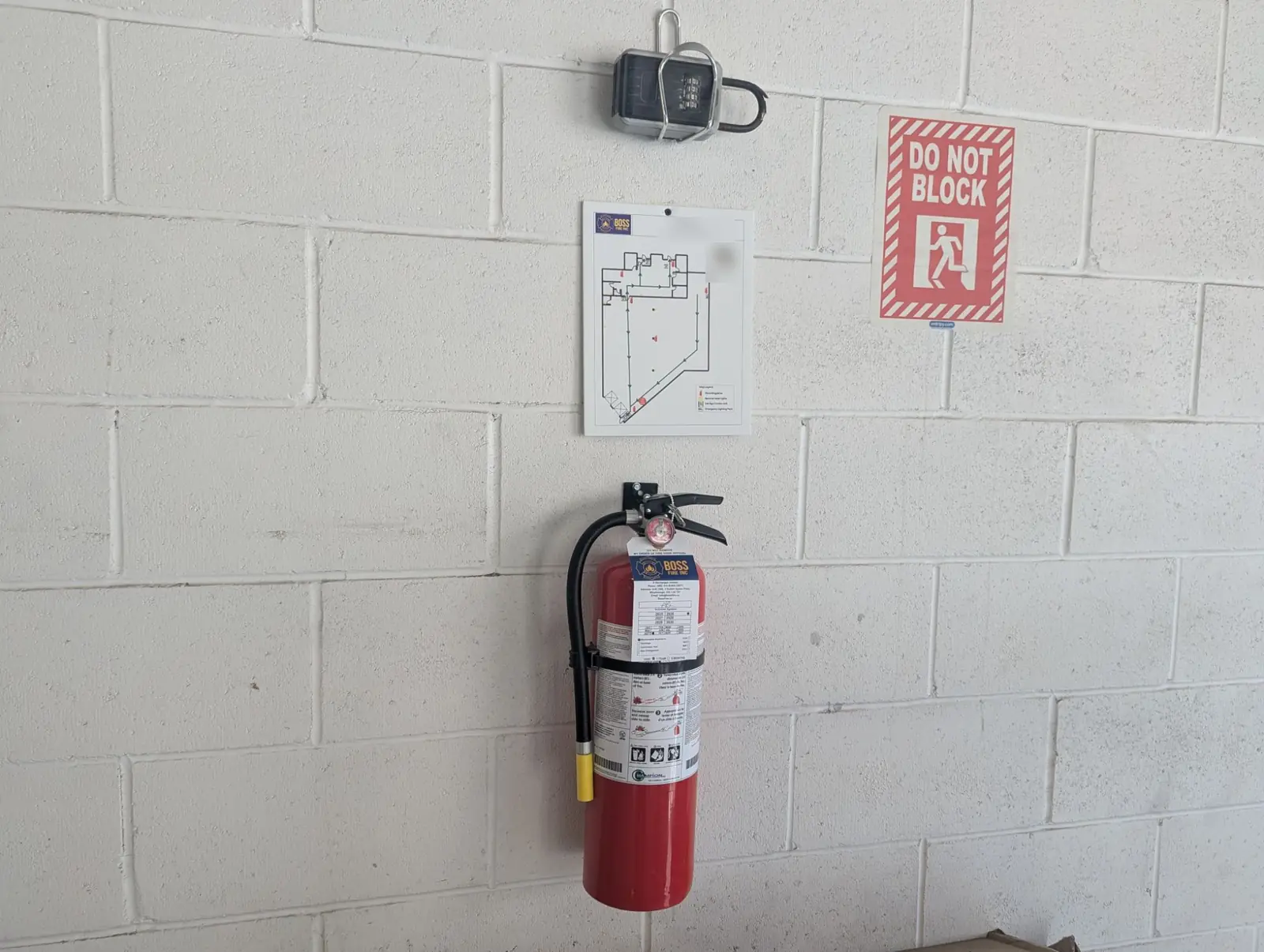
In Ontario, nobody should have to travel more than 25 m to reach a Class A extinguisher. The Fire Code's own table sets that limit, so use it rather than the 75 feet in the US standard.
The Ontario Fire Code sets the number of extinguishers from two limits. Each extinguisher can protect only so much floor area, depending on its Class A rating and the building's hazard grade. Nobody should have to travel more than 25 m to reach one. A light hazard office with 1,500 m² of floor space needs at least three 2-A extinguishers, and more if its layout puts any point farther than 25 m from one.
Ontario's rules come from the Fire Code's own tables. Many websites quote the US standard instead, so the numbers you find online often don't match what an Ontario fire inspector checks.
What decides how many fire extinguishers you need?
Three things set the count: what could burn in each area, how severe a fire there could be, and how far people have to walk to reach an extinguisher.
The hazard grade
The Fire Code grades every area as light, ordinary, or extra hazard, and gives examples of each:
- Light hazard: areas where small fires may be expected, such as offices, schoolrooms, churches, and assembly halls.
- Ordinary hazard: areas where moderate fires may be expected, such as stores, display rooms, auto showrooms, parking garages, light manufacturing, and warehouses not graded extra hazard.
- Extra hazard: areas where severe fires may be expected, such as woodworking, auto repair, mercantile storage areas, warehouses with high-piled combustibles, and processes that use flammable or combustible liquids.
The extinguisher's rating
A higher Class A rating lets one extinguisher protect more floor area. The rating is printed on the label, for example 2-A:10-B:C. Our guide to the types of fire extinguishers explains how to read it.
The travel distance
Travel distance is how far a person walks to reach the extinguisher, around shelving, walls, and equipment. It is not a straight line on the floor plan.
The Ontario rule for Class A extinguishers
Every building needs extinguishers suitable for Class A fires. The Fire Code's Table 6.2.6.A sets two limits for them: the travel distance and the floor area each extinguisher can protect.
The maximum travel distance is 25 m for every rating. The maximum area per extinguisher depends on the rating and the hazard grade:
- 2-A: 600 m² in light hazard, 300 m² in ordinary hazard, and not acceptable in extra hazard
- 3-A: 900 m² light, 400 m² ordinary, 300 m² extra
- 4-A: 1,100 m² light, 600 m² ordinary, 400 m² extra
- 6-A: 1,100 m² light, 900 m² ordinary, 600 m² extra
- 10-A: 1,100 m² light and ordinary, 900 m² extra
- 20-A and 40-A: 1,100 m² in every grade
A floor area smaller than the table's figure still needs one extinguisher of at least the minimum size permitted. Hose stations may replace up to half of the Class A extinguishers the table requires.
Many websites quote 75 feet, about 23 m, as the maximum travel distance. That figure comes from NFPA 10, the US standard. In Ontario, the Fire Code ties extinguisher maintenance to NFPA 10 but sets placement in its own tables, so the Ontario limit is 25 m.
Two worked examples
An office floor
Take an office floor of 1,500 m². Offices are light hazard. A 2-A extinguisher protects up to 600 m² in light hazard, so 1,500 divided by 600 gives 2.5. Round up: the floor needs at least three 2-A extinguishers.
Now check the walk. If the floor is long and narrow, or cut up by private offices, some desks may sit more than 25 m from any of those three units. In that case you add a fourth, or move the three until every point is within reach.
A warehouse
Take a warehouse of 3,000 m² with no high-piled combustibles, so it's graded ordinary hazard. With 2-A extinguishers, each covers 300 m², and 3,000 divided by 300 gives 10 units. With 4-A extinguishers, each covers 600 m², and 3,000 divided by 600 gives 5 units. A higher rating halves the count here.
If the same warehouse stores high-piled combustibles, it becomes extra hazard. The 2-A unit is no longer acceptable. A 4-A unit covers 400 m², and 3,000 divided by 400 gives 7.5, so the warehouse needs at least eight.
Then check the walk again. Racking forces people down aisles, so travel distance in a warehouse often runs longer than the floor plan suggests. The 25 m limit can call for more extinguishers than the area math alone.
Both examples give the minimum count. A site visit settles the real number, because your technician walks the routes, confirms the hazard grade of each area, and checks for the special hazards below.
Extinguishers for special hazards
Class A coverage is the base. These areas add their own requirements on top of it.
Flammable liquids
Areas with flammable or combustible liquids need extinguishers rated for Class B fires, set by Table 6.2.6.B:
- Light hazard: a 5-B unit within 9 m, or a 10-B unit within 15 m
- Ordinary hazard: a 10-B unit within 9 m, or a 20-B unit within 15 m
- Extra hazard: a 20-B unit within 9 m, or a 40-B unit within 15 m
Up to three extinguishers can be combined to meet the rating. Where liquids sit in open containers deeper than 6 mm, the extinguishers must supply at least one unit of Class B rating for every 0.1 m² of surface of the largest container, and the travel distance to reach them can't exceed 15 m.
Electrical rooms
Service rooms containing electrical equipment need extinguishers suitable for Class C fires in or near the room.
Commercial kitchens
Cooking operations need extinguishers suitable for Class K fires. The Fire Code sets no travel distance for them. For comparison, NFPA 10, the US standard, uses 30 feet.
Combustible metals
Shops that handle combustible metals need Class D extinguishers or agents suited to the metal, located no more than 25 m from the hazard.
Where and how to mount extinguishers
The count is only half the job. An inspector also checks where each unit hangs and whether anyone can reach it.
- Height: the top of an extinguisher weighing 18 kg or less must sit no higher than 1.5 m above the floor. For a heavier unit without wheels, the limit is 1.1 m.
- Visible and accessible: extinguishers must be easy to see and reachable at all times. A lockable, break-front glass cabinet is allowed for security.
- Near the way out: extinguishers belong in or beside the corridors and aisles that lead to exits, so a person can grab one on the way out.
- Signs: large floor areas, and spots where visual obstructions can't be avoided, need signs or markings showing where the extinguishers are.
- Clear of the hazard: an extinguisher near a fire hazard has to be reachable without putting the person using it at undue risk.
- Label out: in a cabinet, recess, or shelf, the operating instructions must face outward.
Mounting is part of Boss Fire's annual inspection. If a unit hangs too high or sits behind stock, your technician remounts it to code during the visit.
Get your extinguisher count checked
Boss Fire offers a free site visit for commercial and industrial buildings. An NFPA-certified technician walks your floor, grades each area, measures the routes to your extinguishers, and gives you an itemized quote for anything missing. Quotes are answered the same business day, and in the GTA we can be on site within 48 hours.
We serve the GTA and the surrounding region, from Niagara to Oshawa and north to Barrie, and our Milton-based technician covers Halton and Peel, including Halton Hills. Annual inspection of the extinguishers you already have starts at $40 per extinguisher, per year, plus one service call fee per visit; our post on fire extinguisher inspection cost explains what that covers.
See our fire extinguisher inspection and service page for the full scope, read why fire extinguishers are your first line of defence, and use the Ontario fire inspection checklist for every other system in your building.
Sources and references
- Ontario Fire Code, O. Reg. 213/07, Division B, Articles 6.2.1.3 to 6.2.1.6 (location, access, and signs), 6.2.4.1 to 6.2.4.4 (where extinguishers are required, mounting height, and instructions)
- Ontario Fire Code, O. Reg. 213/07, Division B, Articles 6.2.5.1 to 6.2.5.3 (hazard grades), 6.2.6.2 and 6.2.6.4 to 6.2.6.9 (Class A and Class B distribution, Tables 6.2.6.A and 6.2.6.B), 6.2.6.12, 6.2.6.13, and 6.2.6.16 (Class K, Class C, and Class D)
- NFPA 10, Standard for Portable Fire Extinguishers
Frequently Asked Questions
How many fire extinguishers do I need? +
The Ontario Fire Code sets the number from your floor area, your hazard grade, and each extinguisher's Class A rating. In a light hazard office, a 2-A unit covers up to 600 m², so a 1,500 m² floor needs at least three. You may need more if any spot sits farther than 25 m from an extinguisher.
How far apart should fire extinguishers be? +
The Fire Code sets a maximum travel distance of 25 m to a Class A extinguisher, measured as the distance a person walks. For Class B hazards, the limit is 9 m or 15 m, depending on the extinguisher's rating. Where liquids sit in open containers, the limit is 15 m.
How high should a fire extinguisher be mounted in Ontario? +
For an extinguisher weighing 18 kg or less, the top of the unit must sit no higher than 1.5 m above the floor. For a heavier unit without wheels, the top must sit no higher than 1.1 m.
Does a small unit or office still need a fire extinguisher? +
Yes. Where a floor area is smaller than the area in the Fire Code's table, the Code still requires one extinguisher of at least the minimum size permitted.
Do I need signs for my fire extinguishers? +
The Fire Code requires signs or markings showing where extinguishers are in large floor areas, and anywhere visual obstructions can't be avoided. In a small, open room, a clearly visible extinguisher may be enough.
Need a Fire Safety Assessment?
Our certified technicians handle the full inspection cycle. Same-day service available across the GTA.