
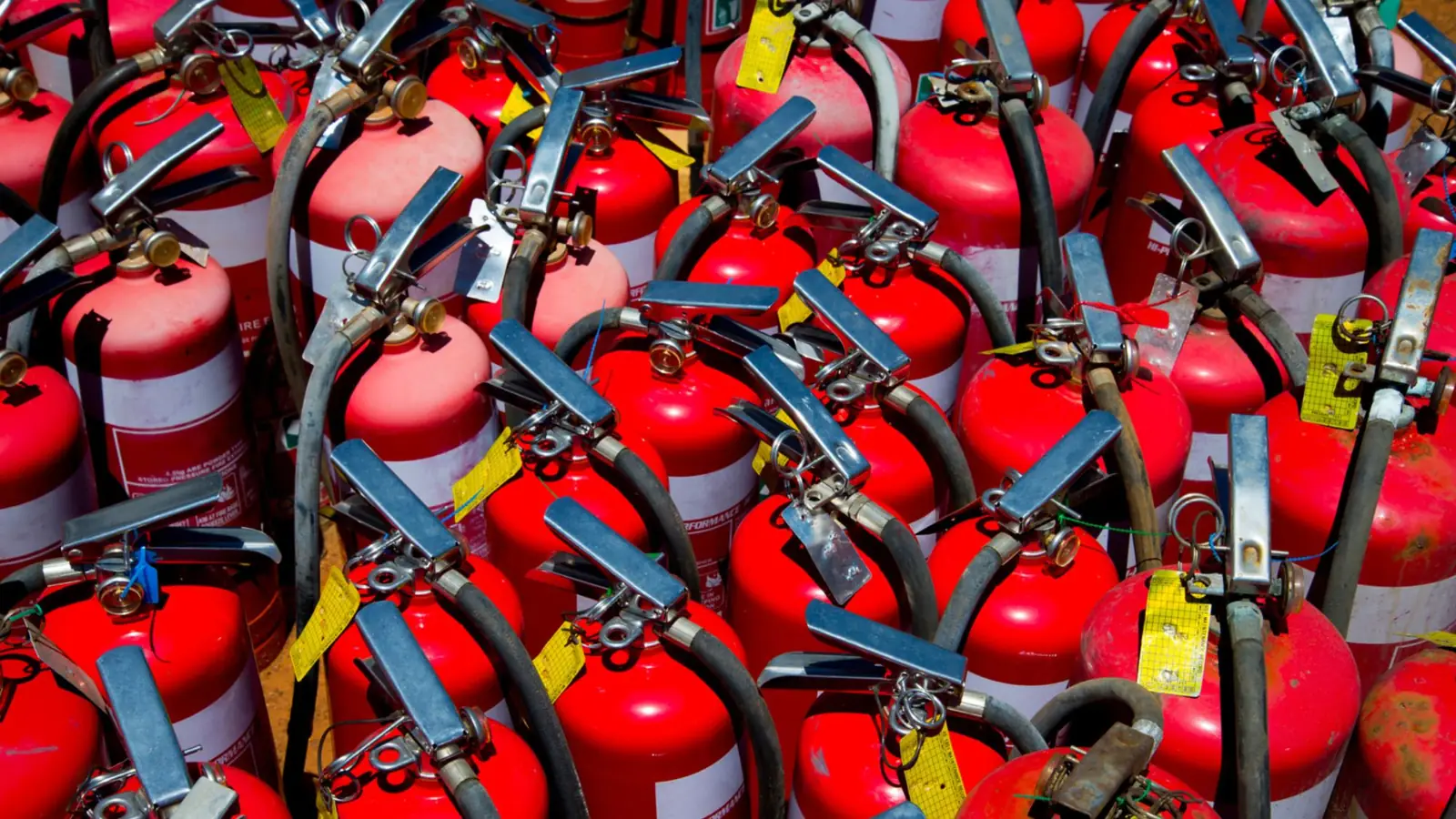
The Ontario Fire Code requires a tag on each extinguisher showing the maintenance date, the servicing company, and the signature of the person who did the work. Check every tag before a fire inspection.
In Ontario, a certified fire extinguisher is one a qualified technician has serviced in conformance with NFPA 10 within the past year, with a signed and dated tag attached to show it. That tag is what a fire inspector checks. Staff training certificates are a separate thing: they cover people, not equipment, and the Fire Code ties training to the supervisory staff named in a building's fire safety plan.
Search for "fire extinguisher certification" and you'll find training courses next to inspection companies. Both are real, and they answer different questions.
What does a certified fire extinguisher mean in Ontario?
The Ontario Fire Code requires portable extinguishers to be maintained and tested in conformance with NFPA 10, the standard for portable fire extinguishers. Certification is the proof that the maintenance happened. It has two parts.
The tag
Each extinguisher must carry a tag, attached securely, that shows:
- the maintenance date
- the servicing agency, meaning the company that did the work
- the signature of the person who performed the service
The Code allows other approved records in place of a tag where they show the same three things. A tag lets an inspector confirm the service on the spot.
The record
The Fire Code also requires a permanent record for each extinguisher. That record lists the maintenance date, the examiner's name, and a description of any maintenance work carried out. The written report your technician leaves after the annual visit is that record. Keep it at the building: the Code requires records to stay there for at least two years, along with the most recent and the previous record of each inspection.
What happens during the annual certification visit
At Boss Fire, the annual inspection on each extinguisher follows NFPA 10 and the Ontario Fire Code. Your technician:
- checks the cylinder, pressure gauge, and label
- makes sure nothing blocks the hose or nozzle
- cleans the unit to look for damage, rust, corrosion, or pitting
- loosens the powder in dry chemical units so it hasn't packed at the bottom
- removes the old tag and fits a new tamper seal
- checks the mounting and remounts the unit to code if needed
- attaches a new tag and records the unit in a written report
A unit that passes gets its new tag on the spot. Annual inspection starts at $40 per extinguisher, per year, plus one service call fee per visit, and our post on what fire extinguisher inspection costs breaks down that price.
How often does a fire extinguisher need to be certified?
Once a year, for the annual maintenance and new tag. Two other intervals sit around it.
- Monthly: the Fire Code requires every portable extinguisher to be inspected monthly. Your own staff can do this walk-through. Keep a simple log of each monthly check, with the date and who did it, so you can show an inspector the checks happen. Our post on how often fire extinguishers need to be inspected has the monthly checklist.
- Longer intervals: some extinguisher types need internal maintenance or a pressure test every several years, depending on the type and the date on the unit. The same post lays out each interval, and your annual report flags any unit that comes due.
When does an extinguisher need recertifying early?
Three situations send a unit back to a technician before its annual date:
- It has been used. The Fire Code requires an extinguisher to be replaced or recharged after use, following the instructions on its nameplate. Treat a unit that was discharged, even partly, as out of service until a technician deals with it.
- It has a defect. The Code requires a defective extinguisher to be repaired so it will work safely. Damage, corrosion, a missing pin or seal, or a low gauge all count.
- The tag has run past a year. A tag older than 12 months tells an inspector the annual maintenance was missed.
When a unit fails its inspection, your written report says which unit failed and why. You get a quote for the replacement, and we replace the unit only after you approve it. The replacement can be on site as soon as the next day.
What a fire inspector checks on your extinguishers
When a fire inspector walks your building, expect them to check your extinguishers for these things:
- that every tag is present, signed, dated within the past year, and names the servicing company
- that each unit is easy to see and accessible, as the Fire Code requires
- that the gauge reads in the operable range and the pin and seal are in place
- that you can produce the maintenance records on request
A missing or expired tag is a Fire Code contravention, and an inspector can order you to fix it. Our Ontario fire inspection checklist covers the other systems an inspector checks on the same visit.
How to keep your certification from lapsing
Tags drift onto different dates when extinguishers are added, replaced, or serviced in different months. A few habits keep the whole building on one renewal date:
- Keep a list of every extinguisher, its location, and the month on its tag. Your written report gives you the starting list.
- Book the annual visit for the month the tags were last signed, so every unit renews together. Units added during the year can join that schedule at the next visit.
- Read the tag date during the monthly inspection, along with the gauge and the pin. A tag a month or two from its anniversary is your reminder to book.
- If a unit is used, damaged, or goes missing, call for service right away instead of waiting for the annual date.
If you manage several properties, one schedule across all of them keeps every site's tags on the same calendar. Our national accounts service is built for businesses with several sites.
What about staff fire extinguisher training?
A fire extinguisher training certificate belongs to a person. It shows that someone completed a course on choosing and using an extinguisher, such as the PASS method. Our post on how to use a fire extinguisher covers the basics.
The Ontario Fire Code handles training through the fire safety plan. In buildings that need one, the plan must provide for training supervisory staff and instructing other occupants in their fire safety duties. The Fire Code does not say every employee must hold an extinguisher training certificate. Workplace safety rules outside the Fire Code may add their own training duties, so check with whoever manages health and safety for your business.
If your building needs a fire safety plan, our post on fire safety plans in Ontario covers who needs one and what goes in it.
Book your annual certification with Boss Fire
Boss Fire inspects and tags commercial and industrial fire extinguishers across the GTA and the surrounding region, from Niagara to Oshawa and north to Barrie, including Brampton and the rest of Peel. Our technicians are NFPA-certified, Boss Fire carries $5 million in liability insurance, and we answer quote requests with an itemized quote the same business day. In the GTA, we can be on site within 48 hours.
See our fire extinguisher inspection and service page for the full scope of a visit.
Sources and references
- Ontario Fire Code, O. Reg. 213/07, Division B, Article 1.1.2.2 (record retention)
- Ontario Fire Code, O. Reg. 213/07, Division B, Article 2.8.2.1 (fire safety plan contents, including training)
- Ontario Fire Code, O. Reg. 213/07, Division B, Articles 6.2.1.3 (visible and accessible) and 6.2.7.1 to 6.2.7.6 (maintenance, monthly inspection, defects, tags, records, and maintenance after use)
- NFPA 10, Standard for Portable Fire Extinguishers
Frequently Asked Questions
How often does a fire extinguisher need to be certified? +
Once a year. The Ontario Fire Code requires maintenance in conformance with NFPA 10, which calls for annual maintenance by a certified technician who then signs and dates a new tag. Your own staff also inspect each unit monthly, and some types need internal maintenance at longer intervals.
What information must be on a fire extinguisher tag in Ontario? +
The Ontario Fire Code requires the tag to show the maintenance date, the servicing agency, and the signature of the person who performed the service. Where other approved records hold the same information, the Code allows those records instead of a tag.
How do I get a fire extinguisher certificate? +
For the extinguisher, book an annual inspection with a fire protection company. The technician services each unit, attaches a signed and dated tag, and gives you a written report for your records. For a person, a certificate comes from completing a training course.
How can I get a fire safety certificate in Ontario? +
For a building, the documents a fire inspector asks for are the service tags and inspection reports for each fire protection system, plus an approved fire safety plan where one is required. For a person, certificates come from training courses. Ask your local fire department which records it expects for your occupancy.
Can I certify my own fire extinguishers? +
Your staff can do the monthly inspection the Fire Code requires. The annual maintenance follows NFPA 10, which calls for a certified technician, and the tag has to name the servicing company and carry the technician's signature.
Need a Fire Safety Assessment?
Our certified technicians handle the full inspection cycle. Same-day service available across the GTA.