
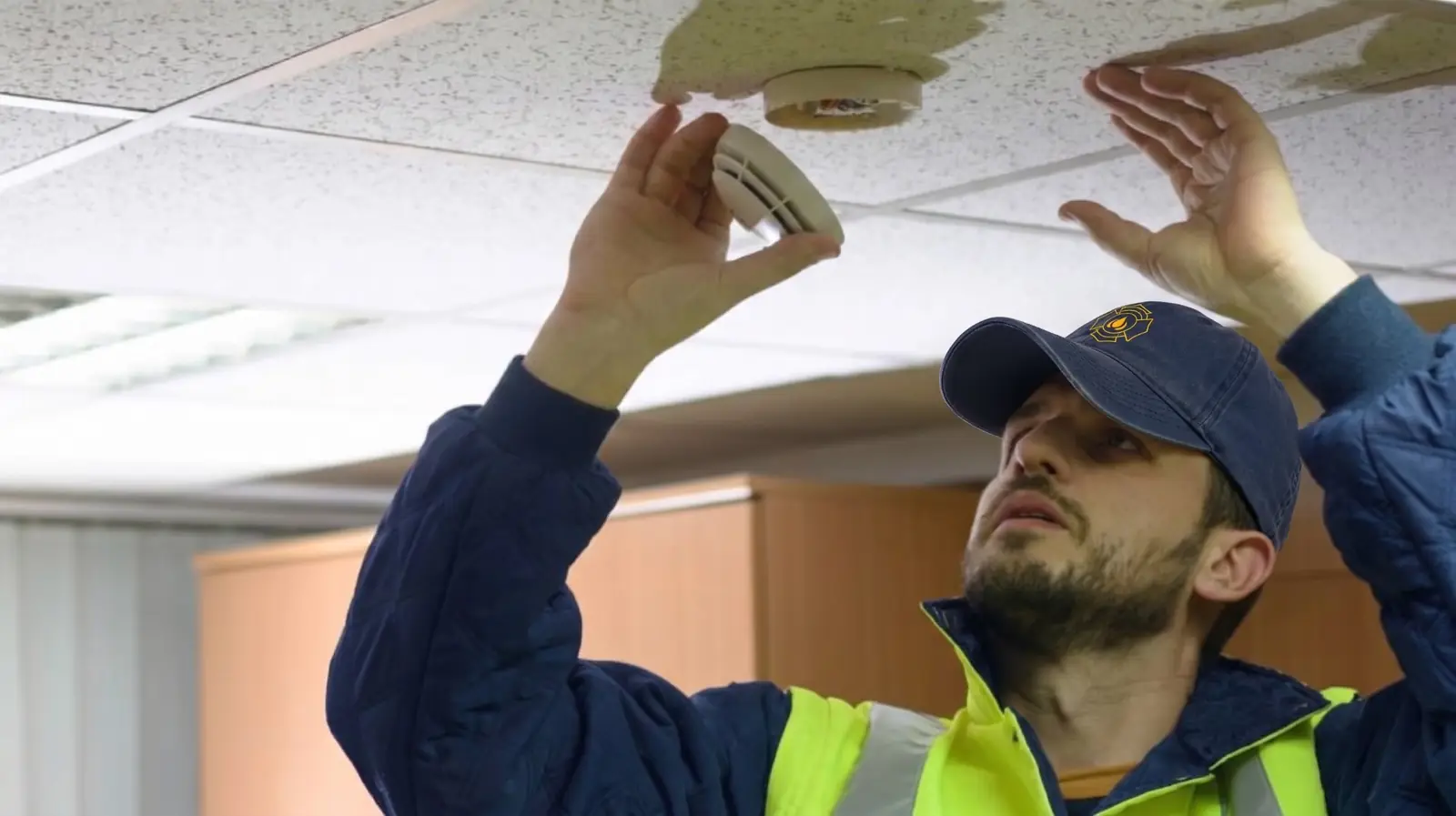
Write down the time, zone, and device for every false alarm. Three alarms from the same detector point a technician straight to the problem.
Commercial fire alarms go off without a fire for a short list of reasons: dust, steam, cooking fumes, dirty or aging detectors, the wrong detector for the space, and wiring faults. Each cause leaves clues on the panel. Find the device that triggered the alarm, match it to the cause, and fix that device so the building stops evacuating for nothing.
The pattern repeats in buildings across the GTA. The alarm sounds at 2 p.m. on a Tuesday, tenants file onto the sidewalk, the fire trucks arrive, and nobody finds smoke. A week later, it happens again, and fewer people leave their desks.
Why does a fire alarm go off when there's no fire?
Each device in a fire alarm system responds to one sign of fire, or to a person who has seen one.
- Smoke detectors respond to particles in the air. Drywall dust, steam, aerosol spray, and theatre fog can look the same as smoke to the sensor.
- Heat detectors respond to temperature. Some trip at a fixed temperature, and others trip when the temperature climbs fast. A portable heater or an open oven door aimed at one can set it off.
- Pull stations respond to a hand. A cart, a ladder, or a curious visitor can trip one as easily as an employee who sees a fire.
A false alarm usually starts with one of these devices reacting to something ordinary. Find the device, and you can usually find what set it off.
The common causes, and the fix for each
Dust and construction work
Sanding drywall, cutting concrete, and sweeping a warehouse floor all send fine particles into the air. A smoke detector over the work area reads them as smoke.
The fix: plan dusty work with your fire alarm contractor before it starts. If a detector has to come out of service while the work goes on, the contractor arranges it with the required notifications and puts it back into service when the work ends. Have the detectors near the work area cleaned or checked afterward, since dust that settles inside a detector can cause alarms for weeks.
Steam and cooking fumes
Office kitchenettes, staff rooms, and break areas are common sources of false alarms. Toasters, microwaves, kettles, and dishwashers all release heat, steam, or fumes, and a smoke detector mounted a few metres away catches them.
The fix: a technician can relocate the detector or replace it with a type better suited to the room. A heat detector, for example, may suit a small kitchenette where a smoke detector keeps reacting to toast. The change has to follow the fire alarm design for the building, so it's a job for your fire alarm contractor.
Dirty or aging detectors
Over the years, dust, insects, and grime build up inside a detector's sensing chamber. The detector becomes more sensitive, or less reliable, and starts reacting to conditions it once ignored.
The fix: the annual inspection catches this. The Ontario Fire Code requires every fire alarm system to be inspected and tested to CAN/ULC-S536 (Article 6.3.2.2), and the record must show whether each device is in proper working order. A technician cleans, retests, or replaces the detectors that fail. Our post on the annual fire alarm inspection explains what that visit covers.
The wrong detector for the space
A smoke detector in a loading dock sees truck exhaust every time the door opens. One mounted next to an air supply vent sees every puff of dust the system pushes out.
The fix: a technician assesses the space and recommends a detector type and location that suit it. Any change goes through your fire alarm contractor, so the system still meets its design.
Humidity and temperature swings
Loading doors that open to winter air, unheated entrances, and rooms that swing between hot and cold can produce condensation inside a detector.
The fix: reduce the swing where you can, with door closers, air curtains, or better heating, and ask your technician whether the detector suits the conditions in that spot.
Damaged or bumped pull stations
Pull stations near loading areas, hallways used by carts, and public entrances take knocks. A broken or loose station can trip on its own.
The fix: replace damaged stations, and ask your fire alarm contractor about a protective cover for stations in high-traffic spots.
Wiring faults
Loose connections, damaged cable, and water in a junction box usually show up as trouble signals, but some faults can produce an alarm. Our guide to fire alarm panel signals explains the difference.
The fix: a technician traces the circuit and repairs it. Wiring work on a fire alarm system belongs to a qualified fire alarm technician.
Tests and work done without notice
A sprinkler contractor flows water to test an alarm, or an electrician works near a detector, and nobody tells the monitoring station. The station sees an alarm and dispatches the fire department.
The fix: notice comes first. For sprinkler systems, the Fire Code requires prior notification of water flow and other tests to everyone who could be affected by an alarm (Article 6.5.5.1). Make the same habit apply to every contractor who works near your fire alarm.
How to find the cause of repeat false alarms
Start a log the next time the alarm sounds with no fire. Record:
- The date and time
- The zone and device the panel reports
- The weather and the season
- What was happening in that area: cooking, deliveries, cleaning, or construction
After three or four entries, a pattern usually appears. The same detector at the same time each morning points to the breakfast toaster. The loading dock detector in January points to cold air and condensation. Hand the log to your technician, and the visit becomes a repair instead of a search.
What not to do after a false alarm
- Don't silence an activated alarm early. Article 6.3.1.5 of the Fire Code says an activated fire alarm must not be manually silenced until supervisory staff confirm, following the fire safety plan, that no fire emergency exists.
- Don't cover, unplug, or remove a detector yourself. Doing so takes part of the system out of service. The Fire Code requires the fire department, occupants, and supervisory staff to be notified whenever any part of a fire alarm system is shut down (Article 6.3.1.3).
- Don't pull the panel's batteries or disable zones. A quiet panel with a disabled zone protects nobody in that zone.
What false alarms cost a business
Some Ontario municipalities charge for repeat false alarm responses. The rules and amounts differ from one municipality to the next, so check your municipality's fees and charges by-law or call its fire department.
The larger costs rarely appear on an invoice. Every evacuation stops work for every tenant in the building. Customers leave a store. After a few false alarms, people start waiting to see whether the next one is real before they head for the exit.
Stop repeat false alarms with Boss Fire
Boss Fire's fire alarm technicians are registered with the CFAA. We read your panel history, find the device behind the alarms, and clean, replace, or relocate it to suit the space. We serve commercial and industrial buildings across the GTA and the surrounding region, from Niagara to Oshawa and north to Barrie. Quotes are itemized and answered the same business day, and in the GTA we can be on site within 48 hours. If your panel goes into alarm after hours and won't stay quiet, the main line, 905-519-BOSS, connects to 24/7 emergency dispatch.
See our fire alarm inspection and monitoring page for what a service visit includes, and use our Ontario fire inspection checklist for every other system a fire inspector checks.
Sources and references
- Ontario Fire Code, O. Reg. 213/07, Division B, Articles 6.3.1.3 (notification when part of a fire alarm system is shut down), 6.3.1.5 (silencing an activated alarm), and 6.3.2.2 (annual inspection and testing to CAN/ULC-S536, and device records)
- Ontario Fire Code, O. Reg. 213/07, Division B, Article 6.5.5.1 (notice before sprinkler water flow tests)
Frequently Asked Questions
What causes false fire alarms in commercial buildings? +
Frequent causes include dust from construction work, steam and cooking fumes near smoke detectors, dirty or aging detectors, a detector type that doesn't suit the space, humidity and temperature swings, damaged pull stations, wiring faults, and tests run without telling the monitoring station. Each one leaves clues on the panel that point to the device involved.
Why does my fire alarm go off when there is no smoke? +
Smoke detectors respond to particles in the air, and dust, steam, aerosol spray, and fog can look like smoke to the sensor. Heat detectors respond to temperature, so a heater or an open oven aimed at one can trigger it. A dirty detector chamber or a wiring fault can also produce an alarm with no fire present.
Can I disconnect a detector that keeps causing false alarms? +
Not on your own. Disabling a detector takes part of the fire alarm system out of service, and the Ontario Fire Code requires the fire department, occupants, and supervisory staff to be notified when any part of the system is shut down. A fire alarm technician should clean, replace, or relocate the device.
Do fire departments charge for false alarms in Ontario? +
Some Ontario municipalities charge for repeat false alarm responses. The amounts and rules differ by municipality, so check your municipality's fees and charges by-law or call its fire department.
How do I prevent false alarms during construction or renovation work? +
Talk to your fire alarm contractor before the work starts. Dust from sanding and cutting is a common trigger. Any detector taken out of service needs the notifications the Fire Code requires, and it must go back into service as soon as the dusty work ends.
Need a Fire Safety Assessment?
Our certified technicians handle the full inspection cycle. Same-day service available across the GTA.