
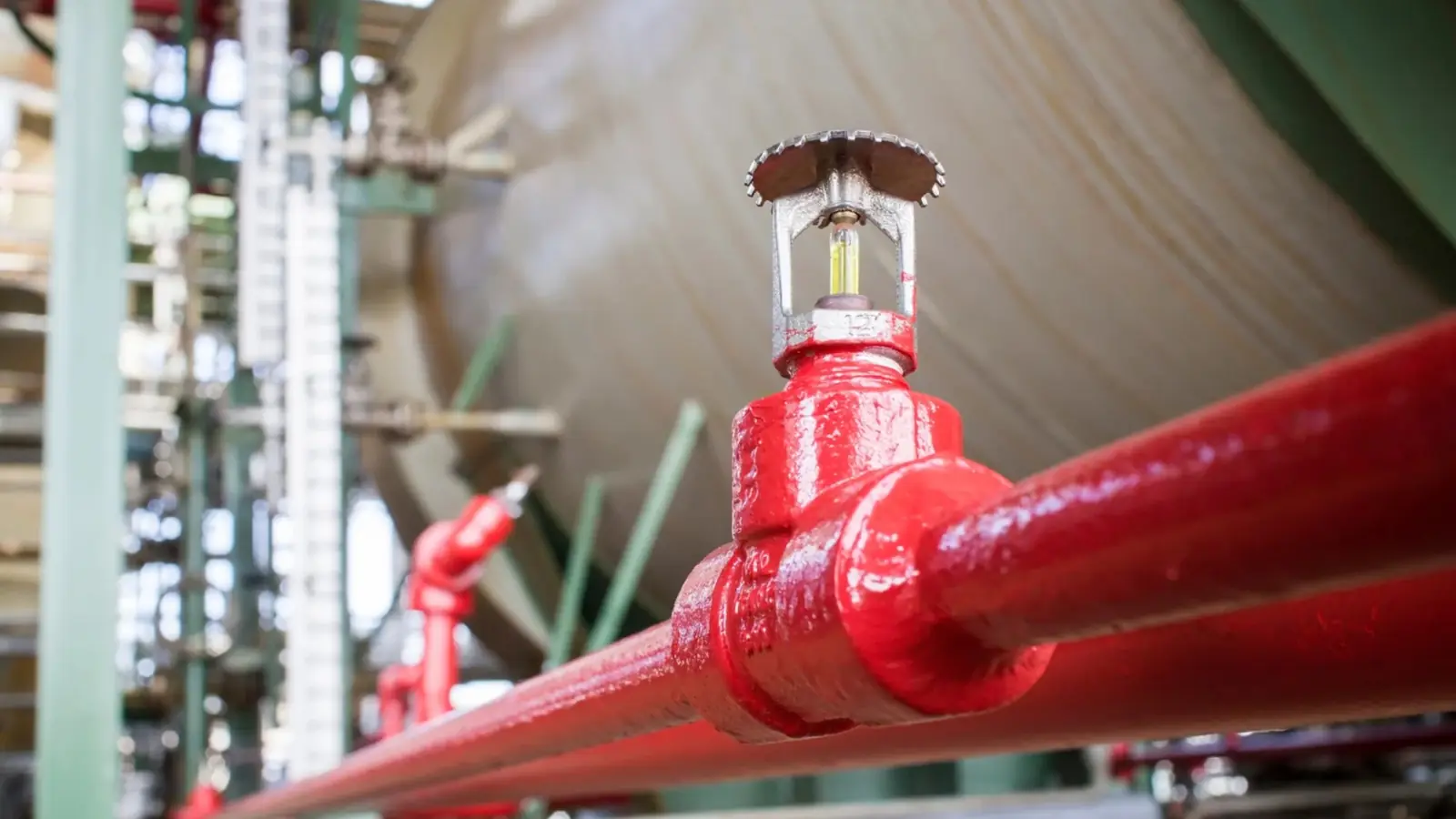
Under Article 6.5.1.3 of the Ontario Fire Code, a sprinkler control valve can't be closed during a fire until the fire is out or the fire department considers it under control. Check for fire first, then deal with the water.
If a sprinkler head goes off in your building, get people away from the area and call 911 unless you can see there is no fire. The Ontario Fire Code says a sprinkler control valve can't be closed during a fire until the fire is out or the fire department considers it under control. Once a fire has been ruled out, a trained person closes the right valve, and the work turns to protecting the building and getting the system back in service.
An open sprinkler head keeps discharging water until someone closes the valve. The first hour decides how much stock, ceiling, and flooring you lose, so work through the steps below in order.
Is there a fire? Decide that first
Every sprinkler activation starts as a possible fire. Heat opens a sprinkler head, and the water flow alarm sounds as soon as water moves through the pipe.
- If you see smoke or flames, or you aren't sure, evacuate the area, call 911, and leave the valve open. The water is doing its job.
- If there is clearly no fire, for example a forklift just struck a head in front of you, the water can be shut off.
Article 6.5.1.3 of the Fire Code is specific. A sprinkler control valve can't be closed in the event of a fire until the fire is extinguished, or the fire department considers it under control by other means. If the fire department is on its way, let the firefighters make that call when they arrive.
How do you stop the water?
Water stops at the sprinkler control valve, not at the head. Your building may have one control valve for the whole system or separate valves for each floor or zone. They usually sit in a sprinkler or riser room near the water service entrance, and each valve should carry a sign or tag showing the area it controls.
- Find the right valve. Close the valve for the zone that is flowing, so the rest of the building keeps its protection.
- Close it fully. Turn the handwheel until it stops.
- Drain the zone if your contractor tells you to. A contractor will usually open the drain to empty that section before replacing the head.
- Stay out from under the head. Don't try to plug or wedge the head yourself. The water is under pressure, and water that has sat in sprinkler pipe for years comes out dark and dirty.
Write down the time you closed the valve. Your sprinkler contractor and your insurer will both ask.
Who should you call?
Make these calls right away, in this order:
- 911, if there is any chance of fire.
- Your monitoring company. If your sprinkler system is monitored, the water flow signal may already have reached them. Tell them what happened and whether the fire department is needed.
- Your sprinkler contractor. Boss Fire offers 24/7 emergency dispatch on the main line, 905-519-BOSS.
- The building owner or property manager, if that isn't you.
- Your insurer, once the water is under control.
The Fire Code adds notification duties. When a sprinkler system or any part of it is shut down, the fire department, the building's occupants, and supervisory staff have to be notified (Article 6.5.2.4). If the repair interrupts the system, the Chief Fire Official has to be told as well (Article 6.5.2.1). Our Ontario fire inspection checklist covers the records and duties for every other system in the building.
Protect the building while you wait
Once the water is off, spend the next half hour limiting the damage:
- Move stock, files, and equipment out of standing water and away from wet ceiling tiles.
- Stay clear of wet electrical equipment, and have an electrician check panels and outlets that got soaked.
- Use squeegees and wet vacuums to move water toward floor drains.
- Cover sensitive equipment below the area with plastic sheeting in case more water drips from the ceiling.
- Photograph the head, the ceiling, the floor, and every damaged item before you clean up.
Sagging ceiling tiles can hold a lot of water. Keep people out from under them until they are removed.
What to tell your insurer
Your insurer will want a clear record of what happened. Gather these while the details are fresh:
- The time the alarm sounded and the time you closed the valve
- What set the sprinkler off, if you know, such as a forklift strike or a frozen pipe
- Photos and video of the head, the ceiling, the floor, and the damaged stock
- A list of damaged items, with quantities
- Your sprinkler contractor's written report on the repair
Keep damaged stock until your adjuster has seen it, unless it creates a safety or health hazard.
Getting your sprinklers back in service
While the valve is closed, that part of the building has no sprinkler protection. The Fire Code expects the work to be planned so the system is back in operation as quickly as possible (Article 6.5.2.3), and full protection has to be restored when the work stops (Article 6.5.2.5).
Your sprinkler contractor will:
- Replace the head with one that matches the original type and temperature rating.
- Refill the system, reopen the control valve fully, and check it is sealed, locked, or electrically supervised.
- Tag any valve that has to stay closed while work continues (Article 6.5.2.6).
- Test the system. If the repair involved the feed mains, cross mains, or risers, the Fire Code requires a pressure test before the system goes back in service (Article 6.5.1.6).
- Give you a written report for your records and your insurer.
Keep that report with your other sprinkler records. A fire inspector or insurer may ask for it later.
Why did the sprinkler go off?
Sprinkler heads open for a reason. When there is no fire, the cause tends to be one of these:
- Physical damage: a forklift mast, ladder, pallet, or piece of stock strikes a head.
- Heat: a head sits too close to a unit heater, an oven, or a skylight that traps summer heat.
- Freezing: a wet pipe in a cold space freezes, splits, and floods when it thaws. Our guide to winterizing commercial sprinkler systems covers prevention.
- Corrosion and age: an old head that has corroded or been painted over can fail.
- Things hung on pipes: the Fire Code doesn't allow the sprinkler system to support anything that would interfere with how it works (Article 6.5.1.5).
Knowing the cause tells you what to fix so it doesn't happen again.
How to prevent the next one
Many accidental activations trace back to something you can spot on a walk-through:
- Install sprinkler guards where heads could be struck. The Fire Code requires guards where there is a possibility of mechanical damage (Article 6.5.6.1).
- Keep stock below the clearance your sprinkler contractor gives you, and keep it off the pipes.
- Have every sprinkler head checked at least once a year for damage, corrosion, grease, dust, and paint (Article 6.5.3.4).
- Keep spaces with wet pipe sprinklers at 4°C or warmer in winter.
Our post on the commercial sprinkler inspection schedule lays out the weekly, monthly, and yearly checks that catch these problems early.
Get emergency sprinkler service from Boss Fire
Boss Fire repairs and inspects commercial sprinkler systems across the GTA and the surrounding region, from Niagara to Oshawa and north to Barrie. Our main line, 905-519-BOSS, carries 24/7 emergency dispatch. For planned work, quotes are itemized and answered the same business day, and in the GTA we can be on site within 48 hours.
See our sprinkler inspection and repair page for the full service.
Sources and references
- Ontario Fire Code, O. Reg. 213/07, Division B, Articles 6.5.1.3 (closing control valves), 6.5.1.5 (obstructions), 6.5.1.6 (testing after repairs), 6.5.2.1 to 6.5.2.6 (shutdowns, notification, and closed valves), 6.5.3.4 (sprinkler head checks), and 6.5.6.1 (sprinkler guards)
- NFPA 25, Standard for the Inspection, Testing, and Maintenance of Water-Based Fire Protection Systems
Frequently Asked Questions
What should I do if a fire sprinkler goes off? +
Get people away from the area and call 911 unless you can see there is no fire. Once a fire has been ruled out, or the fire department says so, a trained person closes the sprinkler control valve. Then call your sprinkler contractor, protect stock and equipment from the water, and photograph the damage for your insurer.
Can a fire sprinkler go off by accident? +
Yes. Sprinkler heads open when they are hit, when they get too hot from a nearby heat source, when a pipe freezes and splits, or when an old head corrodes. In warehouses, a forklift mast or a ladder striking a head is a familiar cause.
If one sprinkler goes off, do they all go off? +
No. In the wet and dry pipe systems found in most commercial buildings, each sprinkler head opens on its own when its heat-sensitive bulb or link reaches its rated temperature. Only the heads near the heat or damage open. Deluge systems, used for some special hazards, work differently.
How do you stop a fire sprinkler from spraying? +
Close the sprinkler control valve that feeds that area, once there is clearly no fire or the fire department has approved it. Don't stand under the head or try to push anything into it. After the valve is closed, a sprinkler contractor replaces the head and puts the system back in service.
Do I have to tell the fire department when my sprinkler system is off? +
Yes. The Ontario Fire Code requires you to notify the fire department, the building's occupants, and supervisory staff when a sprinkler system or part of it is shut down. Repairs that interrupt the system also have to be reported to the Chief Fire Official.
Need a Fire Safety Assessment?
Our certified technicians handle the full inspection cycle. Same-day service available across the GTA.