
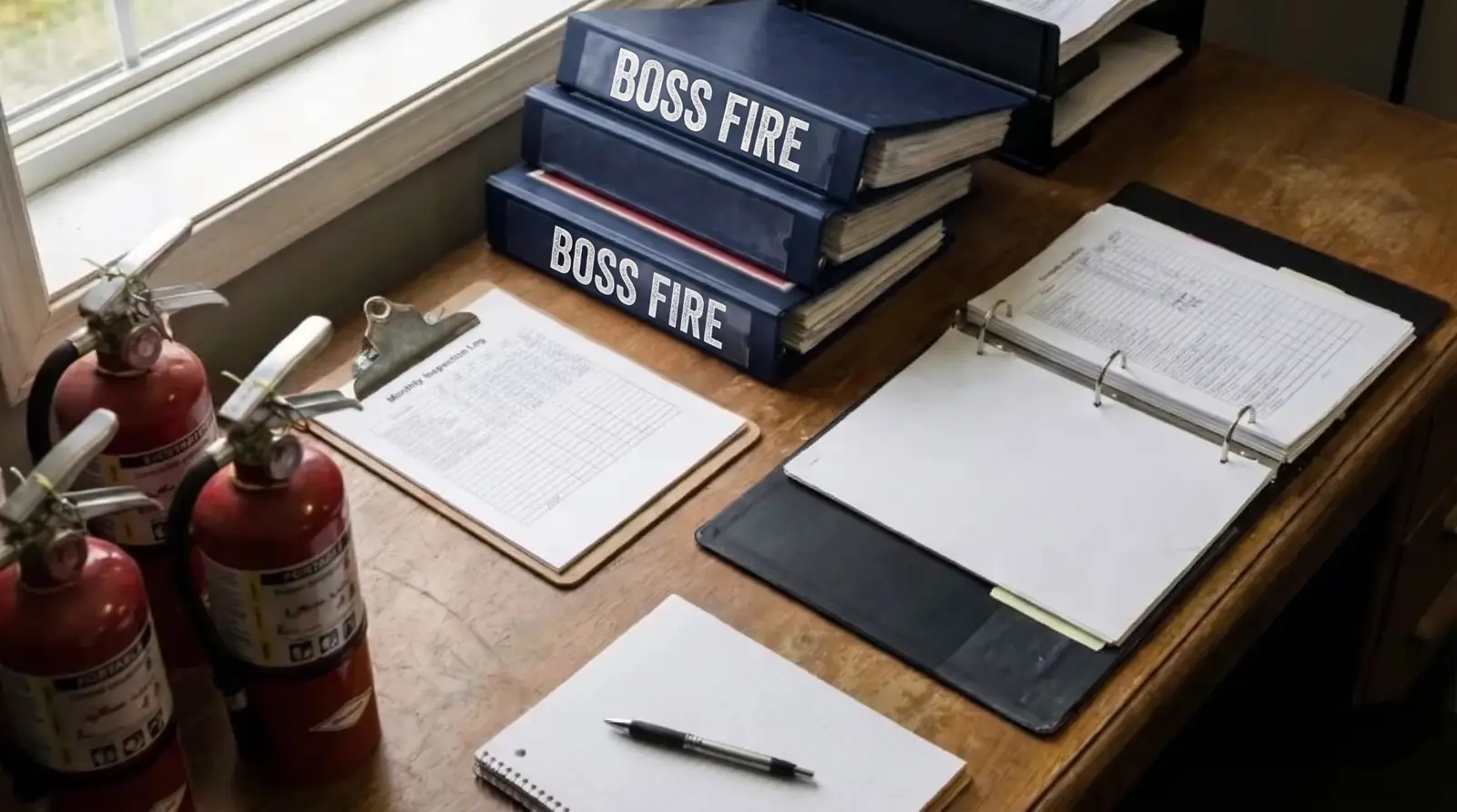
Ontario has no single fire safety certificate for a commercial building. Your proof is the set of inspection reports, tags, and records each system produces, kept at the building for at least two years.
Insurers ask commercial property owners for proof that their fire protection systems are inspected and working. In Ontario, that proof is a set of documents: extinguisher tags and service records, the annual fire alarm inspection report, sprinkler test records, kitchen suppression service reports, emergency lighting test logs, and an approved fire safety plan where one is required. No single provincial certificate covers them all.
The request tends to arrive two weeks before renewal. Your broker sends an email asking for "your current fire inspection certificate," and you open a filing cabinet that holds three years of invoices, one extinguisher report from a company you no longer use, and nothing on the sprinklers. Each system in the building produces its own record, and the Ontario Fire Code says how long to keep each one.
What does an insurer mean by a "fire inspection certificate"?
There's no single document by that name for a commercial building in Ontario. When an insurer, a broker, or a landlord asks for one, they mean evidence that each fire protection system in the building has been inspected on schedule by a qualified company. Each system produces its own record, and the requirements behind each record come from the Ontario Fire Code and the standards it references.
Requests vary by insurer and by policy. One insurer may ask only for the fire alarm and sprinkler reports, while another wants a record for every system. Ask your broker for the exact list, and keep the full set ready anyway, because the next request may ask for more.
The documents to keep, system by system
Portable fire extinguishers
Each extinguisher carries a tag showing the maintenance date, the servicing company, and the signature of the person who did the work. The Fire Code also requires a permanent record for each extinguisher, listing the maintenance date, the examiner's name, and any maintenance or hydrostatic testing done. The annual service report covers that second requirement. Our guide to fire extinguisher certification explains what the tag and the record show.
Fire alarm system
A fire alarm system is inspected and tested every year to CAN/ULC-S536. The Fire Code requires a record of each device, component, and circuit, showing whether it's in proper working order, along with a current description of the system kept in the building. Our post on the annual fire alarm inspection covers what the report contains.
Sprinkler system
Sprinkler inspection, testing, and maintenance follow Section 6.5 of the Fire Code, and compliance with NFPA 25 is deemed to satisfy its inspection, testing, and maintenance subsections (6.5.4 to 6.5.6). The schedule includes weekly gauge checks, annual water flow alarm tests on wet systems, and an annual water supply test with the main drain fully open. Keep the inspection and test records for each visit. Our guide to commercial sprinkler inspection lays out the full schedule.
Kitchen hood suppression
A restaurant or commercial kitchen keeps the service report for its hood suppression system in the same file, with the date of the last service visit easy to find. Our post on kitchen fire suppression systems covers the service schedule.
Emergency lighting and exit signs
Battery emergency lights are inspected and tested every month, and they run for their full design duration under a simulated power failure at least once a year. Exit signs with battery backup follow a monthly and annual schedule too. Keep the monthly log and the annual test record together. If a unit fails its annual test, the repair and the retest belong in the file beside the failure, so anyone reading it can see the problem was closed.
The fire safety plan
Where the Fire Code requires a fire safety plan, the plan has to be approved by the fire department, kept in the building in an approved location, and reviewed at least every 12 months. Keep a copy of the approval with your insurance file, and note the date of the last review.
Fire department reports and orders
If your fire department has inspected the building, keep its inspection report. If it issued an order, keep proof that the deficiencies were fixed and that the order was closed. Our guide to clearing a fire inspection order covers what that proof looks like.
How long does the Fire Code say to keep records?
The Ontario Fire Code sets two rules for any record it requires:
- Two years, and the last two. The original or a copy stays at the building for at least two years after it's prepared, and the most recent record and the one before it must always be on hand.
- Life of the system for initial reports. Initial verification and test reports for fire protection systems installed after November 21, 2007 stay with the building for the life of the system.
That second rule catches buildings that change hands. If you bought a property with a fire alarm or sprinkler system installed after 2007, ask the seller for its initial verification report before closing.
What if a document is missing?
Records go missing for ordinary reasons: a previous contractor went out of business, a tenant moved out with the binder, or an inspection slipped past its date. The fix is the same in each case: book the overdue inspection, and tell your broker the date it's scheduled.
A missing record can complicate a claim, and the effect depends on your insurer and your policy wording. Ask your broker how your insurer treats a gap, rather than guessing.
How to keep the file ready for renewal
Three habits keep the file ready before the broker asks:
- One folder per building. Keep a paper binder at the building, as the Fire Code requires, and a scanned copy of every report in one digital folder you can send from your desk.
- One calendar for every system. Put every inspection date, monthly and annual, on one calendar, with a reminder a month before each annual visit.
- Send the reports before you're asked. When a new report arrives, forward it to your broker. At renewal, the file is already there.
If you manage several buildings, the same calendar across all of them keeps inspections in step. Our national accounts program is built for multi-site portfolios. To find gaps in your own building, run our free compliance checker. For a system-by-system view of what an inspector checks, work through our Ontario fire inspection checklist.
Get current inspection reports from Boss Fire
Boss Fire inspects the systems your insurer asks about: fire extinguishers, fire alarms, sprinklers, kitchen hood suppression, and emergency lighting. Our annual extinguisher inspection starts at $40 per extinguisher, per year, plus one service call fee per visit, and it includes a new dated tag on every unit and a written report for your file. If we inspect your extinguishers and your emergency lighting in the same visit, you pay one service call fee for both.
Our technicians are NFPA-certified, our fire alarm technicians are registered with the CFAA, and Boss Fire carries $5 million in liability insurance. We serve commercial and industrial buildings across the GTA and the surrounding region, from Niagara to Oshawa and north to Barrie. Tell us which reports your broker wants, and we'll answer with an itemized quote the same business day. In the GTA, we can be on site within 48 hours.
Sources and references
- Ontario Fire Code, O. Reg. 213/07, Division A, Article 1.2.1.1 (owner's responsibility) and Article 1.4.1.2 (definition of owner)
- Ontario Fire Code, O. Reg. 213/07, Division B, Articles 1.1.2.2 (retention of records), 2.8.2.1 (fire safety plans), 6.2.7.4 and 6.2.7.5 (extinguisher tags and records), 6.3.2.2 (fire alarm inspection and records), 6.5.1.1, 6.5.3.2, 6.5.5.3, and 6.5.5.5 (sprinkler inspection and testing), and 6.7.1.6 to 6.7.1.8 (emergency lighting and exit signs)
- NFPA 25, Standard for the Inspection, Testing, and Maintenance of Water-Based Fire Protection Systems
Frequently Asked Questions
How can I get a fire safety certificate in Ontario? +
Ontario has no single provincial fire safety certificate for a commercial building. When an insurer or landlord asks for one, they usually mean the current inspection reports for each fire protection system: extinguishers, fire alarm, sprinklers, kitchen suppression, and emergency lighting. If your fire department has inspected the building, its inspection report, or proof that any order was cleared, belongs in the same file.
What fire inspection documents do insurers ask for? +
Requests vary by insurer and by policy, so ask your broker for the exact list. Most commercial requests come down to the annual fire extinguisher service records, the annual fire alarm inspection report, sprinkler inspection and test records, kitchen suppression service reports, emergency lighting test records, and the approved fire safety plan where one is required.
How long do I have to keep fire inspection records in Ontario? +
The Ontario Fire Code requires records to stay at the building for at least two years after they're prepared, and the two most recent records of each test or inspection must always be on hand. Initial verification and test reports for fire protection systems installed after November 21, 2007 must be kept for the life of the system.
Who keeps the fire safety records, the landlord or the tenant? +
The Ontario Fire Code makes the owner responsible for carrying out its provisions unless it says otherwise, and it defines the owner as anyone with control over any portion of the building or property. In a multi-tenant building, the landlord often holds the base building records and each tenant holds the records for equipment in its own space. Your lease decides who arranges and pays for each inspection.
What should I do if a fire inspection record is missing at renewal? +
Book the overdue inspection now and tell your broker the date it's scheduled. Then ask your broker how a gap in records affects your policy, because the answer depends on the insurer and the policy wording.
Need a Fire Safety Assessment?
Our certified technicians handle the full inspection cycle. Same-day service available across the GTA.