
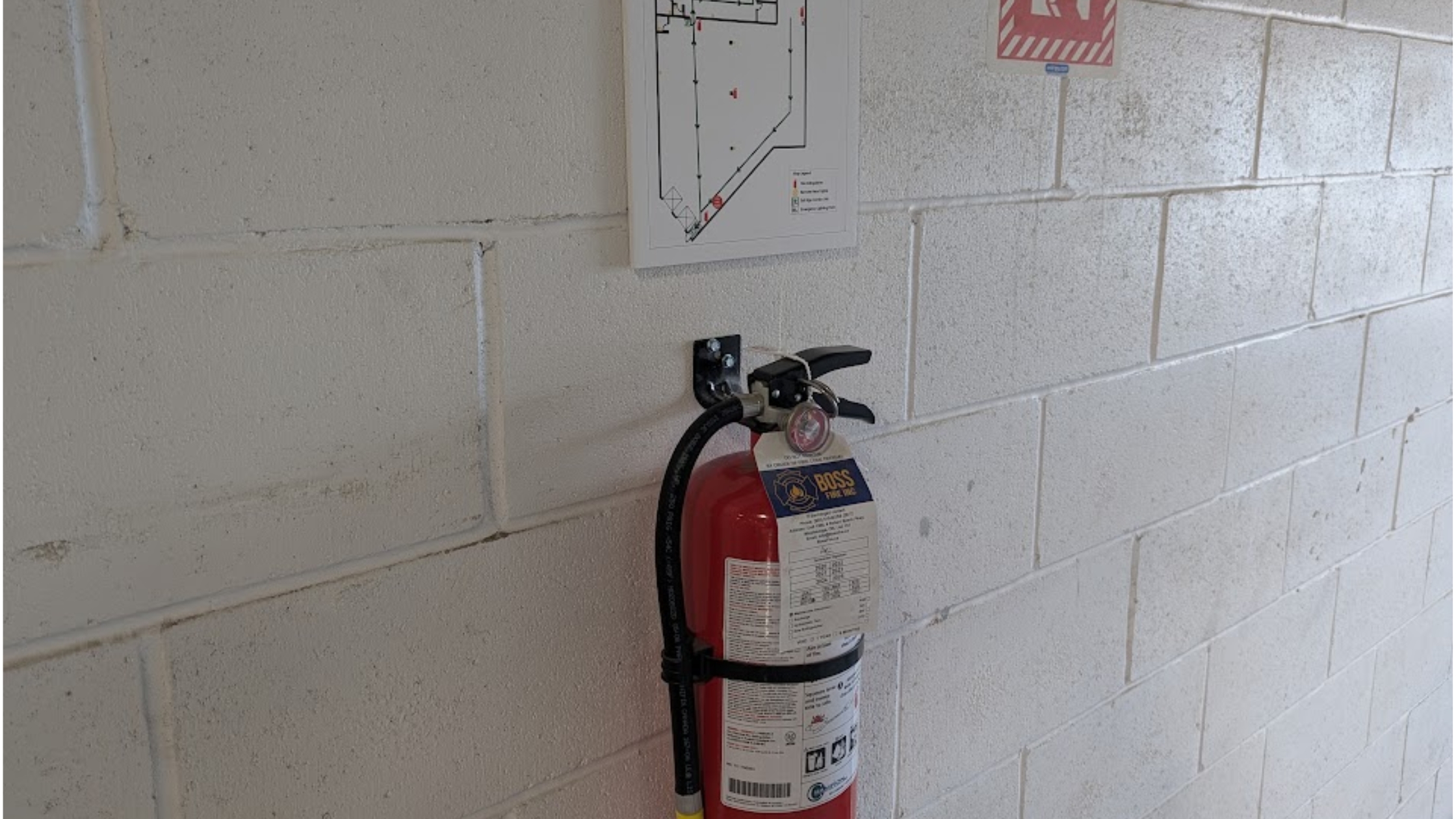
Training is worth very little if the nearest extinguisher is around two corners. Boss Fire checks placement, tagging, and coverage against NFPA 10 across the GTA. Call 905-519-2677.
Most people have walked past the same fire extinguisher hundreds of times and have never once picked it up. That is normal. It is also the reason that the few seconds where it matters tend to go badly.
A portable extinguisher discharges in roughly 10 to 20 seconds. There is no time to read the label, work out the pin, or figure out where to aim. The decision and the technique both have to be in your head before anything happens.
Here is how to use one, and more importantly, how to decide whether you should.
Decide First: Fight or Evacuate
This is the part that gets skipped, and it is the part that keeps people alive.
Fight the fire only if all of these are true:
- The fire is small and contained, roughly the size of a wastebasket or smaller
- It is not spreading
- You have a clear, unobstructed path to an exit behind you
- You have the right extinguisher for that type of fire, and it is fully charged
- The room is not filling with smoke
- Someone has already called 911 or is calling now
Evacuate immediately if any of these are true:
- The fire is larger than a wastebasket or is spreading
- Smoke is filling the room
- You would have to move toward the fire to reach the exit
- You do not know what is burning
- You are not confident using the extinguisher
- Your first attempt did not knock it down
That last point matters. If one extinguisher does not put the fire out, a second one will not either. Leave.
Never let a fire get between you and the way out. Position yourself with the exit at your back before you discharge anything.
The PASS Method
PASS is the standard technique, and it is four steps.
P: Pull the Pin
The pin sits in the handle and is held by a tamper seal, which is a thin plastic tie designed to break easily. Grip the extinguisher by the carrying handle, hold the body steady, and pull the pin straight out sideways. The seal breaks with it.
Pull straight out, not up or at an angle, or the pin can bind against the handle.
A: Aim at the Base of the Fire
This is the step people get wrong. The instinct is to aim at the flames, because that is what you can see. The flames are the result, not the fuel.
Aim the hose or nozzle at the base of the fire, where the burning material actually is. If you aim at the flames, the agent passes straight through the heat and does nothing.
Stand back. For most portable extinguishers, roughly 6 to 8 feet is the right distance. Close enough to reach, far enough to be safe.
One exception: on a CO2 extinguisher, hold the discharge horn by its handle, never the horn itself. The horn becomes extremely cold during discharge and will cause a freeze burn on bare skin.
S: Squeeze the Handle
Squeeze the upper and lower handles together, slowly and evenly. That releases the agent.
Releasing the handle stops the discharge. If you knock the fire down early, you can stop and keep whatever is left in the cylinder in case it reignites.
S: Sweep from Side to Side
Move the nozzle steadily from side to side across the base of the fire, covering the full width of the burning material. Keep sweeping as you work, and keep watching after the flames go down.
If the fire is out, keep your eye on it. Materials retain heat and can reignite. Do not turn your back on it, and do not put the extinguisher away.
After You Use It
Two things, both of which get forgotten.
Never return a used extinguisher to its bracket. Even a one second discharge leaves the unit partially depressurized. A unit that looks full and reads normal on the gauge may not perform when it is needed. Any extinguisher that has been discharged, for any length of time, is out of service until it is dealt with.
Report it. Tell whoever manages fire safety in your building so the unit can be replaced and the incident recorded.
Boss Fire does not recharge or refill extinguishers. We replace discharged units with new, certified, and correctly installed equipment, which removes the question of whether a recharged cylinder will perform.
What Ontario Businesses Need to Know
If you operate a commercial or industrial property, this is not only good practice. Staff training on the location and use of fire equipment is part of your fire safety plan obligations, and inspectors do ask about it.
Two practical points:
Your staff need to know which extinguisher is which. A CO2 unit on a deep fryer fire will spread burning oil. A water unit on energized electrical equipment is dangerous. The label on each extinguisher shows its class rating, and staff should know what the ratings on your units mean.
Your extinguishers need to be where the standard says. Under NFPA 10, no point in a Class A area should be more than 75 feet of walking distance from an extinguisher, and a Class K unit in a commercial kitchen must be within 30 feet of the cooking appliance. Training is worth very little if the nearest unit is around two corners.
The Part Nobody Checks
An extinguisher only works if it is charged, accessible, and current. A monthly visual check takes under a minute per unit: pressure gauge in the green, pin and seal intact, hose clear, unit unobstructed, and tag current.
The annual inspection is the part that requires a certified technician, and it is a legal requirement, not a recommendation.
Boss Fire Inc. provides NFPA 10 compliant inspection, tagging, and replacement for commercial and industrial properties across the GTA. Same day service available.
Call 905-519-2677 or request your free site assessment.
Frequently Asked Questions
What does PASS stand for? +
PASS stands for Pull, Aim, Squeeze, and Sweep. Pull the pin straight out sideways to break the tamper seal. Aim the nozzle at the base of the fire rather than at the flames. Squeeze the handles together slowly to discharge the agent. Sweep from side to side across the base of the fire.
How far should I stand from a fire when using an extinguisher? +
Roughly 6 to 8 feet for most portable extinguishers, which is close enough for the agent to reach and far enough to stay safe. Move closer only as the fire diminishes. On a CO2 extinguisher, always hold the discharge horn by its handle, because the horn becomes extremely cold and can cause a freeze burn.
When should I not use a fire extinguisher? +
Evacuate instead of fighting the fire if it is larger than a wastebasket, if it is spreading, if smoke is filling the room, if you would have to move toward the fire to reach an exit, if you do not know what is burning, or if your first attempt did not put it out.
How long does a portable fire extinguisher last when discharged? +
Most portable extinguishers discharge fully in roughly 10 to 20 seconds depending on size and agent type. That is the entire window you have, which is why the decision to fight or evacuate should be made before you pick the unit up rather than while you are using it.
Do I need to replace a fire extinguisher after using it? +
Yes. Any extinguisher that has been discharged, even briefly, is partially depressurized and must be taken out of service. Never return a used unit to its bracket, because the gauge may still read normal while the unit will not perform. Boss Fire replaces discharged units with new, certified, and correctly installed equipment.
Need a Fire Safety Assessment?
Our certified technicians handle the full inspection cycle. Same-day service available across the GTA.